 Sumas Window
 Nooksack's Climate Is Hard on Siding
Nooksack sits in the low, wet bottomland of the Nooksack River valley, tucked against the Whatcom County foothills a few miles from Sumas and the Canadian border. It's a beautiful place to own a home, and it's also a tough place to own siding. Weather systems pushing in off Puget Sound and the Strait of Georgia bring salt-tinged marine air up the valley, driving rain comes in sideways more months than not, and the combination of river humidity, tree cover, and long gray winters gives moss and algae a head start that lasts most of the year.
Siding here doesn't fail because it's old. It fails because moisture gets behind it, sits there, and nothing was built into the wall assembly to let it dry out. Wood-based products swell and split at the seams. Cheap vinyl chalks, warps in the heat-cold swings, and gaps at the corners let wind-driven rain track behind it. Once water gets trapped, it doesn't matter how nice the siding looks from the street — the sheathing and framing behind it are already in trouble.
Any siding job in Nooksack has to be judged against that reality first. Style and color matter, but moisture management is the actual job.
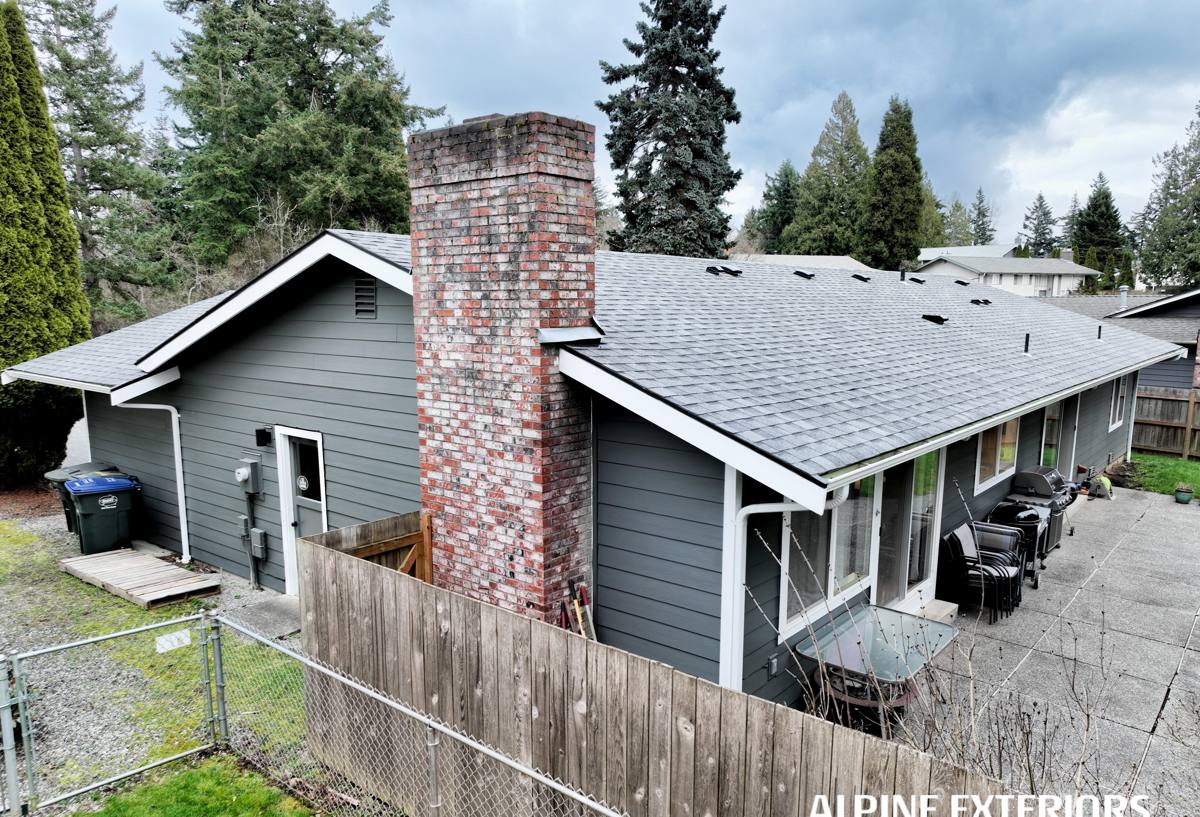
What a Correct Fiber Cement Siding Job Actually Involves
Fiber cement itself is a stable, moisture-resistant material, but a siding job is only as good as the assembly behind the boards. Most siding failures we get called out to inspect in this area trace back to installation shortcuts, not the product itself.
Weather-Resistive Barrier and Flashing
Every wall gets a continuous weather-resistive barrier, lapped correctly from the bottom up so water sheds outward instead of working its way behind the siding. Window and door openings get properly integrated flashing — head flashing, pan flashing at sills, and step flashing where siding meets roof lines. This is the detail that gets skipped most often on rushed jobs, and it's the detail that causes the water damage we see years later.
Fastening and Clearances
Hardie's own installation specs call for minimum clearances from grade, roof lines, decks, and horizontal surfaces — typically several inches — so splashback and standing water don't wick into the bottom edge of the boards. Fasteners have to be the correct type, spaced correctly, and driven flush without overdriving, which cracks the fiber cement and creates an entry point for moisture. We follow the manufacturer's fastening schedule exactly, not "close enough."
Caulking, Trim, and Butt Joints
Butt joints get sealed or backed with flashing tape, not just caulked and hoped for. Trim boards, corner boards, and any penetrations (vents, hose bibs, light fixtures) get sealed with a quality sealant rated for this climate. Small gaps that look cosmetic in month one become moss and rot problems in year three.
Why We Install Only James Hardie Fiber Cement
We made a decision as a company to install one siding system: James Hardie fiber cement. We don't install vinyl, LP SmartSide, Cemplank, Allura, or primed wood siding, and we're upfront about why. Those products aren't junk — vinyl is inexpensive and low-maintenance in mild climates, engineered wood siding is lighter and easier to handle, cedar looks great when it's new. But in a valley climate with this much sustained moisture and moss pressure, each of them carries a maintenance burden or a moisture vulnerability we're not willing to put our name on.
James Hardie fiber cement is non-combustible, engineered specifically for wet climate zones (Hardie's HZ5 formulation is built for exactly this kind of weather), and finished with the ColorPlus factory finish system, which bakes color into the board under controlled conditions rather than relying on field-applied paint that fades and needs recoating. It carries a strong transferable warranty when installed to spec, which matters if the home changes hands. We'd rather install one product correctly, every time, than offer five products and hope the cheaper ones hold up.
Hardie Product Lines That Make Sense for Nooksack Homes
| Product | Look | Best Suited For |
|---|---|---|
| HardiePlank lap siding | Traditional horizontal lap, smooth or cedar-textured | Most home styles; the standard choice for full re-sides |
| HardieShingle | Staggered or straight-edge shingle panels | Craftsman and cottage-style homes, accent gables |
| HardiePanel | Vertical panel with battens | Modern facades, shop-style outbuildings, accent walls |
| HardieTrim | Smooth or textured trim boards | Corner boards, window and door trim, fascia |
Color selection matters more here than in drier climates, since moss and algae show up faster on flatter, lighter tones in shaded, damp areas. We talk through color and sheen with an eye toward how a given home sits relative to sun exposure and tree cover, not just what looks good on a sample chip.
Fiber Cement vs. Other Siding Options
Homeowners weighing a re-side often ask us to compare fiber cement honestly against the alternatives. Here's how they stack up for a climate like this one.
| Material | Moisture Behavior | Maintenance | Typical Lifespan |
|---|---|---|---|
| James Hardie fiber cement | Dimensionally stable; won't rot or swell | Occasional wash; ColorPlus finish resists fading | 30+ years with correct install |
| Vinyl | Doesn't absorb water, but seams and gaps let moisture behind it | Low, but warps/cracks in temperature swings | 15–25 years |
| Engineered wood (LP SmartSide-type) | Wood-based core is moisture-sensitive at cut edges and seams | Requires diligent caulking and repainting | Varies widely with maintenance |
| Cedar | Absorbs and releases moisture; prone to rot without upkeep | High — regular staining/sealing required | 20–30 years with consistent care |
Fiber cement isn't automatically better on every line of that table — vinyl is cheaper up front, cedar has a look some homeowners specifically want. But for a house that has to shed driving rain and resist moss for decades with minimal upkeep, it's the option we're comfortable standing behind.
Signs Your Nooksack Home's Siding Needs Attention
- Soft or spongy spots when you press on the siding, especially near the bottom courses
- Persistent moss or dark streaking that comes back within weeks of cleaning
- Visible gaps, warping, or bowing between boards or panels
- Paint that's peeling, bubbling, or chalking heavily on wood or engineered wood siding
- Cracked caulking around windows, doors, or trim joints
- Rising utility bills that suggest the wall assembly is no longer keeping weather out
- Visible daylight or drafts at siding-to-trim transitions from inside the wall cavity
Our Process, Start to Finish
- On-site evaluation. We walk the home, check current siding and any moisture damage, and look at grade clearances, roof-wall intersections, and trim condition.
- Written estimate. A clear scope covering product selection, tear-off (if needed), flashing and moisture-barrier work, and finish details — no vague allowances.
- Prep and moisture check. Old siding comes off, sheathing is inspected for hidden rot, and any damaged material is repaired before anything new goes up.
- Weather barrier and flashing installation. This is the step that determines whether the job lasts — done to manufacturer spec, not shortcuts.
- Hardie installation. Fastened, spaced, and finished per James Hardie's published install requirements for this climate zone.
- Final walkthrough. We review the finished work with the homeowner and cover basic care going forward.
Cost Factors for Fiber Cement Siding in This Area
| Factor | Why It Affects Cost |
|---|---|
| Home size and wall complexity | More corners, gables, and dormers mean more cutting, trim, and labor time |
| Tear-off and disposal | Removing existing siding, especially if there's hidden moisture damage to repair first |
| Product line and profile | Lap siding, shingle panels, and vertical panel systems price differently |
| Trim and detail work | Corner boards, window trim, and fascia work add labor beyond the field siding |
| Access and site conditions | Sloped lots, tree cover, and tight setbacks near the river bottom can slow the work |
We give real, written numbers after seeing the home in person — not a phone quote based on square footage alone. Hidden moisture damage is the one variable that can change a budget mid-project, which is exactly why we check sheathing condition before finalizing scope.
Why Hire a Crew That Already Works in Nooksack
Siding crews from outside this region sometimes treat wet-climate details as optional add-ons rather than the core of the job. A crew that works this valley regularly already knows how far to keep siding off grade given the river bottom's drainage patterns, how much clearance to leave near roof valleys that funnel heavy runoff, and which sides of a house need the most attention for moss and algae. We also know the practical side — permitting expectations in Whatcom County, realistic scheduling around the wet season, and what actually holds up here versus what looks good in a showroom.
That local pattern recognition doesn't show up on a spec sheet, but it's the difference between a siding job that looks good for one summer and one that's still doing its job in year twenty.
If you're weighing a re-side or want an honest read on whether your current siding still has life left in it, we're glad to take a look. Reach out for a free, no-pressure estimate — we'll walk the house with you, tell you what we actually see, and give you a straight number in writing.