 Sumas Window
 Why Nooksack Homes Are Hard on Siding
Nooksack sits in one of the wetter corners of Whatcom County, tucked between the Nooksack River bottomland and the foothills that catch weather rolling in off the Salish Sea. That combination means three things for the outside of a house: long stretches of driving, wind-pushed rain that hits walls sideways instead of falling straight down; a moss and algae season that can run eight or nine months out of the year on north- and west-facing walls; and enough salt-tinged marine air moving up the valley to accelerate corrosion on fasteners, trim, and anything with exposed metal. None of that is unique to Nooksack, but the intensity and duration of it is more than a lot of siding products were designed to handle.
We see the results on a lot of the homes we get called out to: cupped and delaminating lap boards, caulk joints that failed years before the warranty said they should, and moss lines creeping up from grade because the bottom courses stay damp longer than they ever get to dry. A siding system for this area has to manage water at every joint, resist moisture intrusion into the substrate, and hold its finish without constant homeowner upkeep. That's the standard we hold every Nooksack job to.
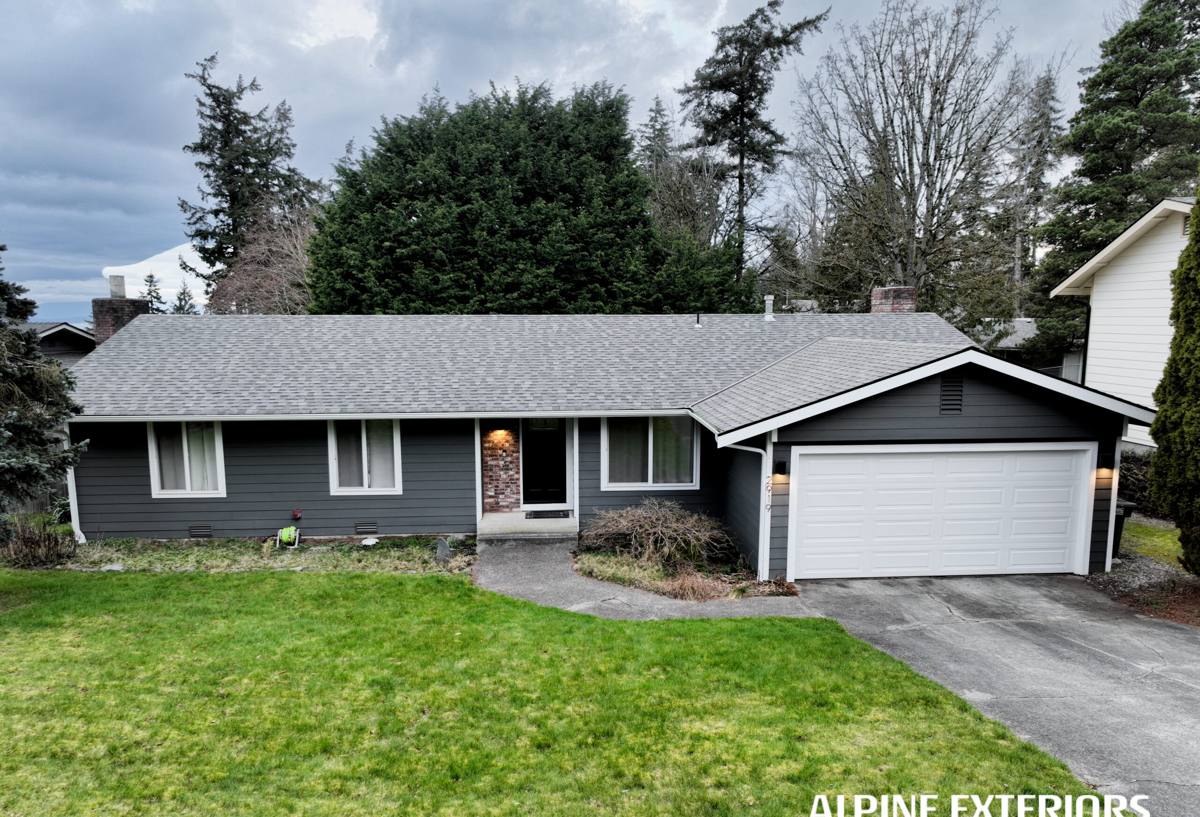
Why We Only Install James Hardie Here
We install James Hardie fiber cement siding exclusively — no vinyl, no LP SmartSide, no Cemplank or Allura, no primed spruce or cedar. That's not a marketing position, it's a practical one built on what actually holds up under Whatcom County's wet cycle year after year.
Fiber cement is made from cement, sand, and cellulose fiber, which means it doesn't absorb and swell the way wood-based products can, and it doesn't soften or warp under sustained UV and moisture exposure the way vinyl can over a couple of decades. James Hardie's ColorPlus factory finish is baked on under controlled conditions rather than field-painted, which matters a lot in a climate where you rarely get more than a few consecutive dry days to paint a house correctly. And Hardie backs the product with a long, transferable limited warranty on both the substrate and the ColorPlus finish — something that carries real weight if you sell the house down the road.
The HZ5 Engineering Difference
James Hardie makes region-specific formulations, and the Pacific Northwest falls under their HZ5 engineering zone, built for high-moisture, freeze-adjacent climates. HZ5 boards are engineered for better moisture management and durability in exactly the conditions Nooksack sees most of the year — sustained damp, temperature swings, and the freeze-thaw cycles that show up in the foothills in winter. That's the line we install on every job out here; it's not an upgrade, it's the correct product for this zip code.
What Correct Installation Actually Involves
Fiber cement siding is only as good as the installation behind it. A huge share of the siding failures we get called to inspect aren't product failures at all — they're water management failures from an install that skipped steps that don't show up until years later.
Water Management and Flashing First
Before a single board goes up, the wall needs a correctly lapped weather-resistant barrier, properly integrated flashing at every window, door, and horizontal trim transition, and rainscreen or drainage gap detailing appropriate to the wall assembly. In a climate that gets as much wind-driven rain as this one does, the siding is really the second line of defense — the drainage plane behind it is what keeps bulk water from ever reaching the sheathing.
Fastening and Clearances
Hardie has specific fastening patterns, nail penetration depths, and butt-joint treatment requirements, and they matter more here than in a dry climate because a loose or over-driven fastener becomes a moisture entry point that gets tested every week of the year. We also hold to Hardie's minimum clearances — siding held up off grade, decks, and roof lines — so the bottom courses aren't sitting in standing water or snowmelt runoff during the wet months.
Joint Treatment and Finish Protection
Butt joints, corners, and trim transitions get properly caulked and, where called for, back-primed on cut edges, since a factory ColorPlus finish only protects the face and edges Hardie already sealed — any field cut needs to be treated the same way or it becomes the weak point in the whole wall.
Our Process on a Nooksack Job
We run every project the same way, whether it's a full re-side or a repair-and-match:
- On-site assessment — we look at existing moisture damage, wall assembly, drainage detailing, and sun/wind exposure on each elevation before we ever talk product.
- Tear-off and substrate check — old siding comes off, sheathing gets inspected for rot or soft spots, and anything compromised gets addressed before new material goes up, not covered over.
- Weather barrier and flashing install — this is the step that determines whether the house stays dry for the next 30 years, so we don't rush it.
- HZ5 Hardie install — correct fastening, clearances, and joint treatment per Hardie's published specs for this climate zone.
- Final walkthrough — we go over caulking, trim, and finish with the homeowner before calling the job done.
Local Conditions That Change the Approach
A few things about siding a home in Nooksack specifically change how we plan a job compared to, say, a drier inland town:
- North- and west-facing walls need extra attention to moss and algae exposure and may benefit from ColorPlus finishes that hold up better against organic growth staining.
- Homes closer to the river bottomland often have higher ambient humidity and slower drying times, which raises the importance of rainscreen detailing behind the siding.
- The marine-influenced air moving up from the coast carries enough salt to accelerate corrosion on cheap or exposed fasteners, so we spec corrosion-resistant fastening on every job here regardless of what the minimum code calls for.
- Long wet seasons mean fewer dry-weather install windows, so scheduling and sequencing matter — we don't install over wet sheathing or during active rain.
How James Hardie Compares to the Alternatives
We get asked fairly often why we don't offer vinyl or LP SmartSide as a lower-cost option. Here's the honest comparison for a climate like this one:
| Factor | James Hardie (HZ5) | Vinyl | LP SmartSide / wood-based |
|---|---|---|---|
| Moisture absorption | Non-absorbent cement composition | Doesn't absorb, but can warp/buckle with heat | Engineered wood strand — vulnerable at cut edges and unsealed joints |
| Finish durability in constant damp | Factory-baked ColorPlus, long finish warranty | Color molded in, fades with UV over time | Field or factory finish, needs edge sealing and regular maintenance |
| Fire rating | Non-combustible | Combustible, can melt/deform | Combustible |
| Moss/algae resistance | Good with proper finish; cleans well | Moderate; can trap moisture behind panels | Susceptible if moisture reaches the substrate |
| Typical lifespan installed to spec | Multiple decades with warranty backing | 15–25 years before fading/warping issues | Highly install-dependent; edge failure is common failure point |
None of these alternatives are junk products — vinyl is cheap and low-maintenance in the right climate, and engineered wood siding performs fine when it's detailed and maintained perfectly. But "detailed and maintained perfectly, forever, in a climate that rains nine months a year" is a high bar, and it's the reason we standardized on fiber cement instead of carrying multiple product lines with different risk profiles.
What Drives Cost on a Nooksack Siding Job
Every house is different, but these are the factors that move the price up or down on a real estimate:
| Factor | Why it matters |
|---|---|
| Existing wall condition | Rot or soft sheathing found during tear-off adds repair scope before new siding goes up |
| Home size and wall complexity | Dormers, gables, and cut-up elevations take more labor per square foot than a simple rectangular wall |
| Board profile and accent details | Lap width, shingle-style accents, and trim boards all price differently |
| Color | Standard ColorPlus colors vs. custom-matched finishes |
| Access and site conditions | Steep grade, tight lot lines, or landscaping that limits staging area affects labor time |
We don't quote off a phone call — every estimate starts with an actual look at the walls, because the tear-off condition is usually the single biggest variable.
Maintenance Checklist for Nooksack Homeowners
Even with a fiber cement system done right, a little seasonal attention keeps it looking good and protects the warranty:
- Rinse siding annually, focusing on north- and west-facing walls where moss and algae build up fastest
- Keep gutters clear so overflow doesn't run down the wall face during heavy rain
- Trim back landscaping and tree cover that keeps siding shaded and damp longer than the rest of the house
- Check caulk joints at trim and window transitions every year or two and re-caulk any that have opened up
- Keep an eye on grade clearance — mulch beds and landscaping that creep up over time can bring soil contact too close to the bottom courses
Why It Matters to Hire a Crew That Already Works This Area
Siding specs on paper look the same everywhere, but the judgment calls — how much clearance to leave at grade given this particular drainage pattern, which elevations need extra flashing attention, how to sequence a job around a wet forecast — come from having actually worked houses in this specific stretch of Whatcom County. A crew that mostly works drier or more sheltered areas can install Hardie correctly by the book and still miss the details that matter most where rain is heavier and more sustained. We size up every Nooksack job against what we've seen hold up and what hasn't in this exact climate, not a generic install checklist.
If you're weighing a re-side or dealing with siding that's already showing moss, cupping, or failed caulk lines, we're happy to take a look and walk you through what we'd actually recommend for your walls — no pressure, no upsell to a product we don't stand behind. Request a free estimate below and we'll get out to take a look.