 Sumas Window
 Why Siding Choice Matters More in Everson Than Most Places
Everson sits in the Whatcom County lowlands, close enough to the Salish Sea to pick up salt-laden air on a west wind, and close enough to the Cascade foothills to get pounded by driving, sideways rain when a system rolls through. Add a moss season that can stretch from late fall into early summer in shaded, north-facing spots, and you have a climate that is genuinely tough on exterior building materials. This isn't marketing talk — it's the reason siding that performs fine in a drier inland climate can fail early here, and it's why the approach to a siding job in Everson has to be different from a generic install.
Homeowners in this area typically notice the problem in one of three ways: paint that won't hold on wood or composite siding, soft or delaminating panels near ground level and under downspouts, or a persistent green-black film on north and west walls that pressure washing only knocks back for a season. All three point to the same underlying issue — moisture that gets in faster than it can dry out.
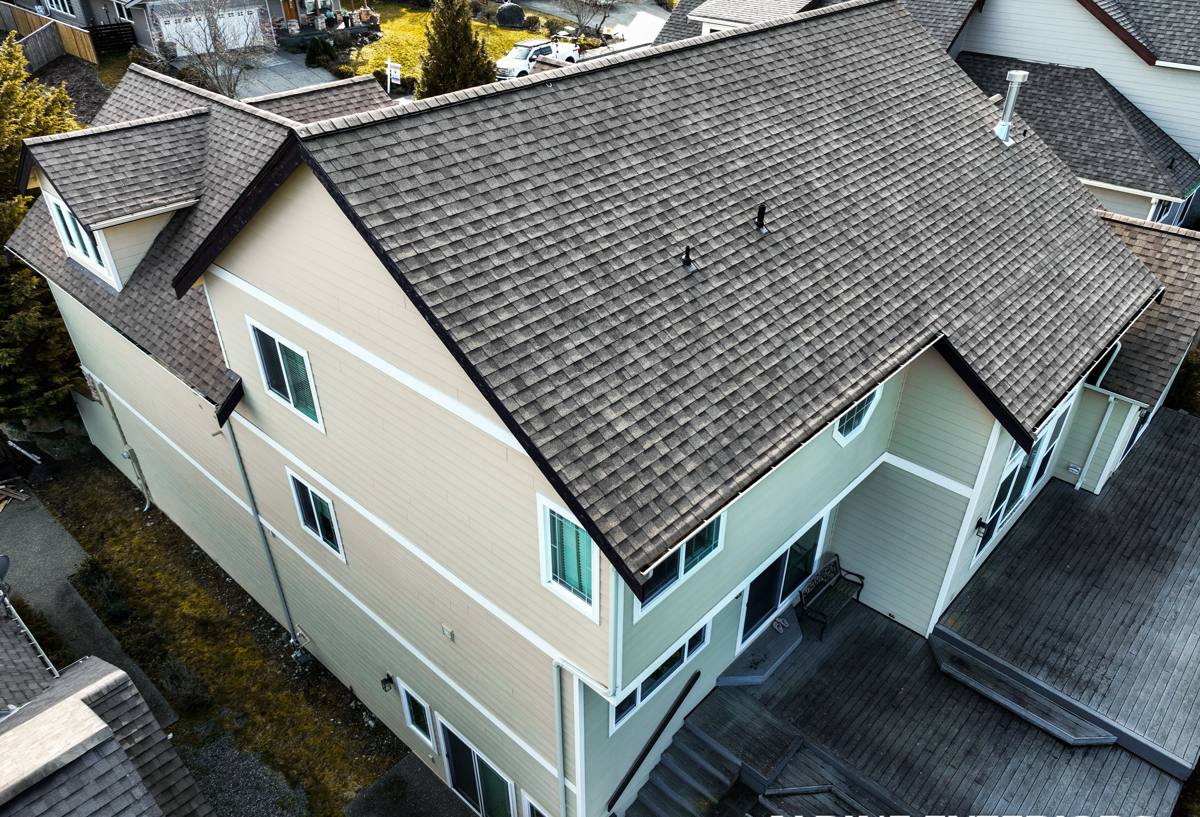
What Salt Air, Driving Rain, and Moss Actually Do to Siding
Salt Air
Airborne salt is corrosive to exposed metal fasteners, flashing, and trim, and it accelerates the breakdown of lower-quality paint films. Over years, that shows up as rust bleed at nail heads and premature fading or chalking on south- and west-facing walls.
Driving Rain
Wind-driven rain doesn't just wet a wall's surface — it forces water sideways and upward under laps, around window and door trim, and into any gap in the water-resistive barrier. A siding system that relies on caulking alone to keep water out, rather than a properly built drainage plane, will eventually let moisture behind the cladding.
Extended Moss Season
Moss and algae thrive wherever a wall stays damp and shaded — under eaves, along fence lines, and on the north side of most Everson lots. Beyond the cosmetic issue, moss holds moisture against the siding surface for months at a time, which is exactly the condition that rots wood-based products and stresses paint bonds on almost anything.
What a Correct James Hardie Installation Looks Like Here
James Hardie fiber cement is engineered specifically for climates like this one — it's non-combustible, dimensionally stable, and doesn't absorb and swell with moisture the way wood or wood-composite products do. But the product is only half the equation. A correct install is what actually keeps water out, and in a high-moisture area like Everson, a few details matter more than they would in a drier climate.
- A real drainage plane — a code-compliant water-resistive barrier plus a gap (often a rainscreen furring strip) behind the siding so any moisture that does get past the cladding can drain and dry instead of sitting against the sheathing.
- Correct fastener pattern and depth — Hardie panels have specific nailing schedules; under- or over-driven fasteners are one of the most common causes of early failure and warranty denial.
- Proper flashing at every penetration — windows, doors, hose bibs, light fixtures, and deck ledgers all need step or head flashing, not just a bead of caulk.
- Minimum ground clearance — Hardie's own installation guidance calls for clearance above grade, decks, and roof lines so splashback and standing water don't sit against the bottom course.
- Factory-primed or ColorPlus-finished cut edges sealed — every field cut needs to be sealed per Hardie's instructions, or that edge becomes the weak point in an otherwise good installation.
Skip any one of these and the siding itself is almost beside the point — water will find the shortcut. This is also where a lot of siding jobs quietly go wrong: the material on the truck is fine, but the crew treats the install like it's the same everywhere, without adjusting for a wet coastal climate.
Why We Install Only James Hardie — and What That Means for This Job
We don't install LP SmartSide, vinyl, Cemplank, Allura, primed spruce, or cedar. That's a deliberate standard, not a lack of options. Wood and wood-composite sidings need paint film and caulking to stay ahead of moisture indefinitely, which is a harder bet to win in a climate with this much sustained dampness and moss pressure. Vinyl is inexpensive and low-maintenance but it moves with temperature, can crack in impacts, and its color is baked in with no realistic way to refinish it once it fades or gets brittle.
James Hardie's fiber cement is cement, sand, and cellulose fiber — it doesn't rot, it doesn't feed pests, and it's non-combustible, which matters given wildfire-season smoke and ember exposure has become a real conversation even west of the Cascades. The ColorPlus factory finish is baked on and backed by its own finish warranty, which takes the "will the paint hold up out here" question mostly off the table. For Everson specifically, we lean toward Hardie's HZ10 climate-engineered product line, which is formulated for wetter, colder regions — it's a small distinction on a spec sheet, but it's the kind of detail that separates a generic Hardie install from one actually built for this weather.
Our Process for an Everson Siding Job
- On-site assessment — we walk the exterior, check for hidden moisture damage around windows, trim, and the lower wall courses, and look at drainage, grading, and roof runoff patterns specific to the lot.
- Tear-off and sheathing check — old siding comes off and we inspect the sheathing underneath before anything new goes up. Soft or rotted sheathing gets replaced, not covered over.
- Water-resistive barrier and drainage plane — installed per code and per Hardie's specifications, with attention to how it laps and ties into window and door flashing.
- Hardie panel or lap installation — fastened to spec, with all field-cut edges sealed and correct clearances maintained at grade, decks, and roof lines.
- Trim, flashing, and caulking — at every penetration and transition, using materials rated for this climate rather than the cheapest compatible option.
- Final walkthrough — we go over the finished job with the homeowner, including what routine maintenance to expect and what's covered by warranty.
What Drives Cost on an Everson Siding Project
| Factor | Impact on Cost | Why |
|---|---|---|
| Extent of hidden sheathing damage | High | Rot found after tear-off has to be repaired before new siding goes on — this is the most common source of budget surprises |
| House shape and trim complexity | Medium-High | Dormers, multiple gables, and lots of window/door trim mean more cutting, flashing, and labor time |
| Siding profile (lap vs. panel vs. shingle-style) | Medium | Material and labor pricing varies by Hardie product line and profile |
| Story height and access | Medium | Two-story and steep-lot homes require more scaffolding/staging |
| Full tear-off vs. install over existing | Medium | Removing old siding adds labor but lets us verify and fix what's underneath — the right call in a wet climate |
| Color and finish selection | Low | ColorPlus factory colors vs. field-painted affects material cost modestly |
We give firm, itemized numbers after the on-site assessment — general per-square-foot figures floating around online rarely account for what a tear-off actually finds on a given house.
Living With James Hardie Siding in This Climate
Hardie siding is genuinely low-maintenance compared to wood or wood-composite, but "low-maintenance" isn't "no-maintenance" in a place with a moss season this long. A little seasonal attention goes a long way toward protecting the investment.
- Rinse siding annually, focusing on north- and west-facing walls and anywhere overhung by trees
- Keep gutters clear so overflow doesn't run down the wall face and feed moss growth
- Trim back vegetation and tree limbs that shade the siding and keep it damp longer than the rest of the house
- Re-caulk joints and penetrations if you notice cracking or gaps — caulk is a maintenance item, not a permanent seal
- Watch for soft spots, dark staining, or lifted caulk near ground level, which usually mean water is getting behind the siding somewhere
- Avoid pressure-washing directly into laps or seams; a garden hose and soft brush are safer for the finish
Why a Crew That Already Works Everson Matters
Whatcom County permitting requirements, typical lot drainage patterns, and the practical realities of working around this area's wet-season scheduling window are all things a crew learns by doing the work locally, not by reading a spec sheet once. A crew that's already done Hardie installs around Everson and the greater Sumas area knows what the local moisture exposure actually demands, has the material sourcing dialed in so a job doesn't stall waiting on backordered trim, and can plan install timing around the wettest stretches of the year instead of fighting them. That local track record is also what makes the ColorPlus and Hardie manufacturer warranties worth something — a warranty only protects you if the installation behind it was done to spec in the first place.
Signs Your Everson Home May Need New Siding Soon
- Paint that's peeling, bubbling, or won't hold for more than a couple of years
- Soft or spongy siding when pressed near the bottom courses or under windows
- Persistent moss or algae staining that returns within months of cleaning
- Visible warping, cupping, or gaps opening up at seams and corners
- Rising energy bills that coincide with drafts near exterior walls
- Siding that's simply reached the end of its expected service life and is due before it fails outright
If your Everson home is showing any of these signs, or you're planning ahead rather than reacting to a problem, we're happy to take a look and give you an honest read on what's going on and what it would take to fix it right. There's no cost and no pressure to a walkthrough and estimate — just a straight answer on where your siding actually stands.