 Sumas Window
 Why Abbotsford Roofs Wear Differently Than Roofs Inland
Abbotsford sits close enough to the coast, and close enough to the Fraser Valley's damp low ground, that roofs here take a different kind of beating than roofs even fifty miles inland. The combination that matters most is moisture that doesn't leave quickly, wind that drives rain sideways under loose flashing, and enough salt-tinged air moving through the valley to accelerate corrosion on exposed metal. None of these problems show up overnight. They show up as a moss mat that's been quietly holding water against shingles for three winters, or a fastener that rusted through because nobody upgraded to the right grade of hardware when the roof went on.
A new roof installation done right in this area isn't just "put shingles on a house." It's a set of decisions about materials, ventilation, and detailing that account for how much water this roof will see over its lifetime, and how long that water sits before it evaporates or drains.
Moss Season Is Longer Than Most Homeowners Expect
North-facing slopes and roofs shaded by mature trees can stay damp for weeks at a stretch through fall, winter, and early spring. Moss doesn't just look bad — it lifts shingle edges, holds moisture against the roof deck, and works its way under flashing at valleys and penetrations. A roof installed without moss-resistant strategy (proper ventilation, the right shingle spacing, and in some cases zinc or copper strips) will show moss again within a few seasons, regardless of how good the shingle brand is.
Wind-Driven Rain and Salt Air
Storms coming off the coast don't just drop rain straight down — they push it sideways and upward under eaves, at ridge caps, and around chimneys and vents. Combined with the salt content in the air this close to Georgia Strait weather systems, standard fasteners and flashing can corrode faster than the shingles themselves wear out. That's why the flashing and fastener choices on a new roof matter as much as the shingle brand — a roof is only as good as its weakest metal component.
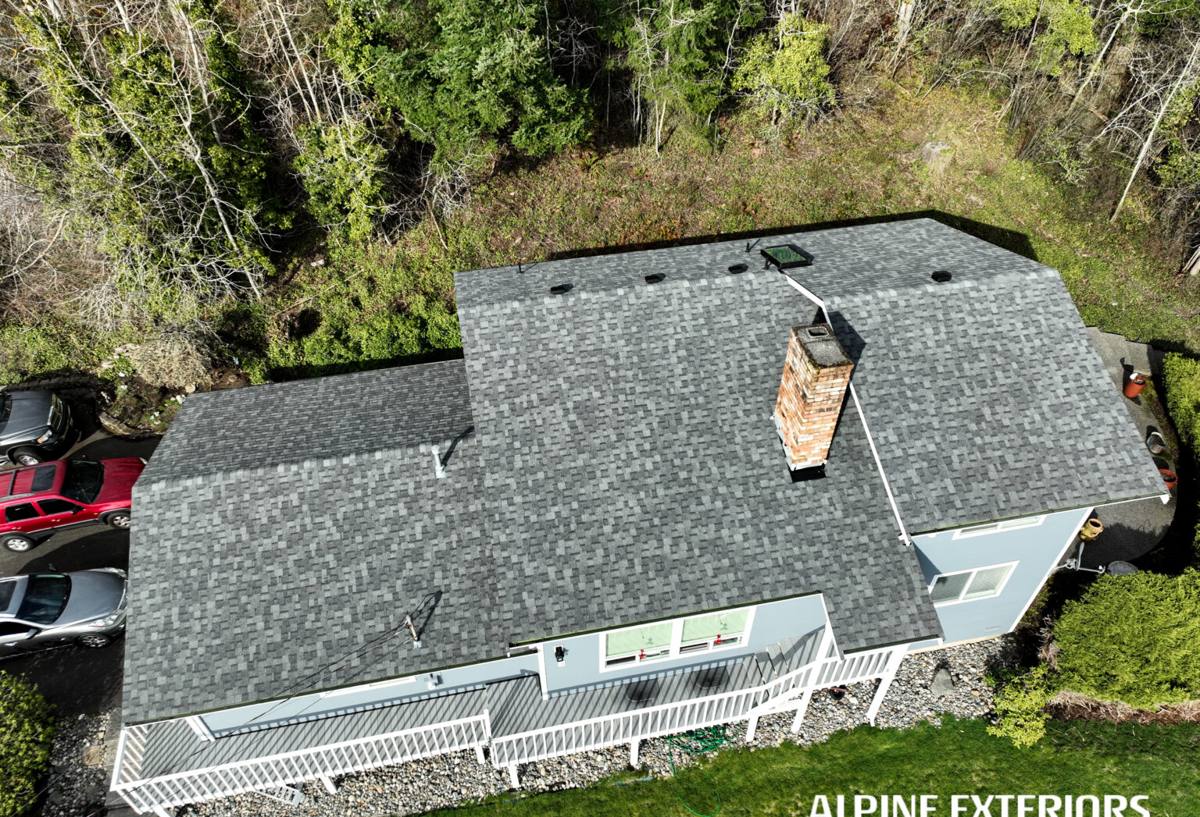
What a Correct Roof Installation Actually Involves
A roof that lasts its full rated life in this climate is built in layers, and every layer has a job. Skipping or shortcutting any one of them is usually where premature leaks and moss problems start.
- Full tear-off to bare decking — layering new shingles over old traps moisture and voids most manufacturer warranties.
- Deck inspection and repair — soft, delaminated, or water-stained plywood or OSB gets replaced before anything new goes down, not covered up.
- Ice-and-water shield at eaves, valleys, and around all penetrations, not just where code minimums require it.
- Synthetic underlayment across the full deck for a secondary water barrier under the shingles.
- Properly lapped step and counter-flashing at walls, chimneys, and skylights — this is where most leaks originate on older roofs.
- Balanced intake and exhaust ventilation so the attic doesn't trap moisture that condenses and rots the deck from underneath.
- Corrosion-resistant fasteners and flashing metal appropriate for a coastal-influenced climate.
Material Choices for This Climate
There isn't one "correct" roofing material for Abbotsford — the right choice depends on the roof's pitch, how much shade and moss exposure it gets, and what the homeowner wants to spend up front versus over the life of the roof.
| Material | Moss/Moisture Behavior | Typical Lifespan | Trade-Offs |
|---|---|---|---|
| Architectural asphalt shingle | Good with proper ventilation and algae-resistant granules; still needs periodic cleaning on shaded slopes | 25–30 years | Best cost-to-performance balance for most homes |
| Standing seam metal | Sheds moss and water fast due to smooth, steep-shedding surface | 40–50+ years | Higher upfront cost; needs correct fastener spec to avoid galvanic corrosion near coastal air |
| Synthetic/composite shingle | Resists moisture absorption well; performance varies by manufacturer | 30–50 years (varies) | Premium pricing; fewer local installers familiar with the product |
| Cedar shake | Attractive but holds moisture and is the most moss-prone option without diligent maintenance | 20–30 years with upkeep | Highest maintenance burden in this climate |
For most Abbotsford-area homes, an architectural asphalt shingle with a good ventilation package delivers the best balance of upfront cost, appearance, and moisture performance. Metal earns its higher price on steep, shaded, moss-prone roofs where shedding water fast matters more than anything else.
How We Approach a New Roof Installation Here
- On-site assessment — pitch, shade exposure, current moss/moisture damage, attic ventilation, and any deck soft spots visible from inside the attic.
- Material and ventilation plan — matched to that specific roof's exposure, not a one-size-fits-all package.
- Tear-off and deck repair — full removal, replacement of any compromised sheathing, and a clean nailing surface.
- Water barrier and underlayment — ice-and-water shield at vulnerable points, synthetic underlayment across the field.
- Flashing detail work — valleys, chimneys, skylights, and wall transitions get new, correctly lapped flashing rather than reused metal.
- Shingle or panel installation — installed to manufacturer spec, including nail placement and exposure, which directly affects wind and warranty performance.
- Ventilation balancing — intake at the soffits, exhaust at the ridge, sized to the attic volume.
- Final walkthrough — cleanup, magnetic nail sweep, and a review of the finished roof with the homeowner.
Ventilation and Moisture Control Deserve Extra Attention
An underventilated attic is one of the most common reasons a new roof underperforms in this region. Without enough intake and exhaust airflow, warm moist air from the living space condenses against the underside of a cold roof deck through the wet months. Over a few years that shows up as deck rot, mold on the sheathing, and premature shingle failure from underneath — a problem that has nothing to do with the shingle brand and everything to do with how the roof system was designed. Getting the intake-to-exhaust ratio right, and making sure insulation isn't blocking the soffit vents, is part of doing the installation correctly the first time.
Permits and Working Across the Border
Abbotsford falls under British Columbia building code and City of Abbotsford permitting, which differs in some particulars from Washington State and Whatcom County requirements just across the line in Sumas. A roofing crew that regularly works both sides of the border knows which permits apply, what inspections are required, and how local code treats things like ice-and-water shield coverage and ventilation minimums — details that matter for passing inspection and for insurance purposes down the road.
What Drives the Cost of a New Roof
| Factor | Why It Matters |
|---|---|
| Roof size and pitch | Steeper roofs take longer to work safely and use more material per square |
| Deck condition | Rotted or delaminated sheathing found during tear-off adds material and labor |
| Material selection | Asphalt, metal, and synthetic options span a wide cost range, as shown above |
| Number of penetrations | Chimneys, skylights, and vents each require careful, time-consuming flashing work |
| Ventilation upgrades | Adding proper intake/exhaust venting where none existed is worth the added cost |
| Access and staging | Steep lots, tight driveways, or multi-story homes affect equipment and labor time |
Every honest roofing quote should walk through these factors specifically for your roof rather than quoting a flat per-square rate that ignores pitch, access, and deck condition.
Why It Matters That a Crew Already Works Abbotsford
A contractor who regularly works this specific area already knows which neighborhoods sit in heavier shade and see moss faster, which roof orientations catch the worst of the driving rain, and how local code and inspection expectations run on both sides of the Sumas–Abbotsford border. That familiarity shows up in small decisions — where to add extra ice-and-water shield, how much ventilation a particular attic actually needs, which flashing metal holds up best against this air — that a crew unfamiliar with the region might not think to make.
Signs Your Roof May Already Need Attention
- Moss visible on north-facing slopes or in shaded valleys
- Granules collecting in gutters or at downspout outlets
- Curling, cupping, or missing shingles after a windy storm
- Daylight visible through the attic roof deck
- Water stains on ceilings or in the attic near chimneys or vents
- Rusted or visibly corroded flashing and fasteners
- A roof approaching or past 20–25 years old with asphalt shingles
If your roof is showing any of these signs, or you're planning ahead rather than reacting to a leak, we're glad to walk the roof with you and give a straight assessment. Fill out the form below for a free, no-pressure estimate on new roof installation for your Abbotsford home.