 Sumas Window
 Bellingham's Climate Is Rough on Siding — Here's Why
Bellingham sits where marine air off the water meets a wet, mossy, tree-shaded landscape, and that combination is tougher on exterior siding than most homeowners realize. Homes here deal with three distinct stresses at once: salt-laden air moving in off the bay, wind-driven rain that hits walls sideways instead of falling straight down, and a moss season that can run eight or nine months out of the year on shaded north and west-facing walls. Any one of these will shorten the life of a poorly-installed siding job. Together, they expose weak installation work fast — usually within the first two or three wet seasons.
Salt Air and Coastal Moisture
Homes closer to Bellingham Bay pick up airborne salt that settles on exterior surfaces and accelerates corrosion of fasteners, trim flashing, and any metal components tied into the siding system. Salt also holds moisture against a wall longer than dry inland air would, which matters a lot once you're talking about what's happening behind the siding, not just on its face.
Driving Rain
Storms coming off the water don't just fall on a roof — they push rain sideways into wall assemblies, seams, and butt joints. A siding installation that relies on caulk and hope instead of proper lapping, flashing, and drainage gaps will eventually let that water find a way in, usually at corners, window returns, and the bottom courses near grade.
Moss and Prolonged Dampness
Whatcom County's long wet season means shaded siding stays damp for extended stretches, and that's exactly the environment moss and mildew need to take hold. Moss doesn't just look bad — on the wrong siding material, sustained dampness at the surface can soften the substrate over time, especially at edges and cut ends that weren't properly sealed during installation.
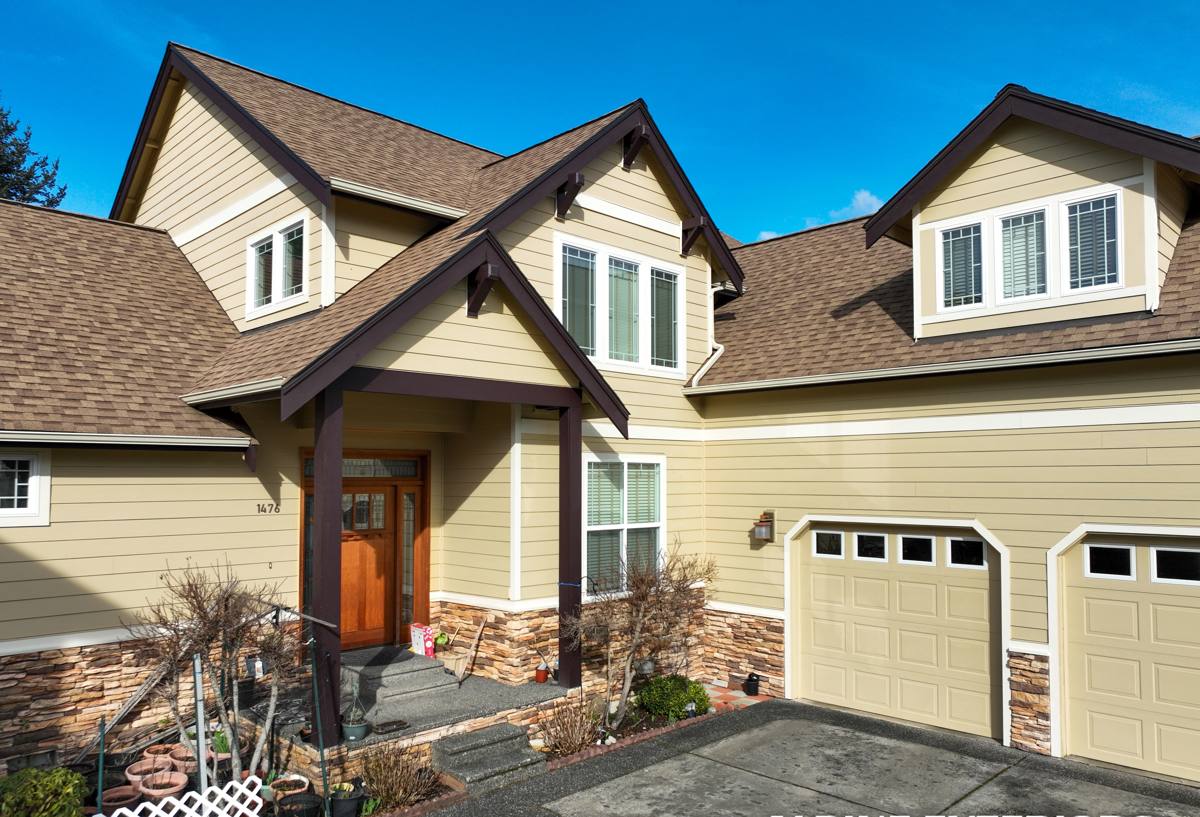
What a Correct Siding Job Actually Requires in This Climate
A siding installation that's going to hold up in Bellingham isn't just about the panels you see — it's about everything underneath them. Most premature siding failures we get called out to inspect trace back to shortcuts taken during the parts of the job that are invisible once the wall is closed up.
- Weather-resistant barrier installed correctly and lapped shingle-style so water sheds outward, not into the wall cavity
- Proper flashing at every window, door, and penetration, integrated with the weather barrier rather than just caulked over the top
- Drainage gap behind the siding so any moisture that does get past the outer layer can drain and dry instead of sitting against the sheathing
- Correct fastener type and placement — the right nail or screw, at the right depth, in the right location on the panel, using corrosion-resistant fasteners given the salt exposure
- Proper clearance at grade so the bottom edge of the siding isn't sitting where splash-back and standing moisture can attack it
- Sealed cut ends on every field cut, not just factory edges
Skip any one of these and you can still end up with a wall that looks fine on installation day and starts showing problems two or three winters later.
Why We Only Install James Hardie Fiber Cement
We made a deliberate decision to install one siding system — James Hardie fiber cement — and not vinyl, LP SmartSide, or other engineered wood products. That's not a sales pitch; it's a standard we hold ourselves to because of what we've seen this specific climate do to siding over time.
Non-Combustible and Dimensionally Stable
Fiber cement doesn't expand and contract with moisture the way engineered wood products can, and it isn't affected by the sustained dampness that moss season brings. It also won't ignite, which matters given how many Whatcom County properties border trees and brush.
Built for This Region
James Hardie engineers its HZ5 product line specifically for climates that see a lot of moisture, and the Pacific Northwest is exactly the kind of region that product line was designed around. Combined with the factory-applied ColorPlus finish, you get a surface that resists the fading, cracking, and peeling that field-applied paint struggles with under constant damp-dry cycling.
Warranty That Follows the Product
Hardie backs its siding with a strong, transferable material warranty — something that matters to homeowners who may sell in the next decade and want that protection to carry over to the next owner rather than evaporating at closing.
We don't install vinyl siding, LP SmartSide, Cemplank, Allura, or unfinished cedar or spruce siding. Each of those products has legitimate uses, but none of them line up with the moisture exposure and maintenance expectations we've standardized around for this region.
Our Bellingham Installation Process
- On-site assessment — we look at your home's exposure (how much wind-driven rain and shade it actually gets), existing wall condition, and any signs of past moisture intrusion before quoting anything.
- Tear-off and sheathing check — removing old siding lets us actually inspect the sheathing underneath for rot or soft spots before covering it back up. This step catches problems a lot of quick re-siding jobs miss entirely.
- Weather barrier and flashing — installed and integrated as a system, not layered on as an afterthought.
- Furring or drainage plane where the wall assembly calls for it, so moisture has somewhere to go besides deeper into the wall.
- Hardie panel installation — correct fastener spacing, correct clearances at grade, trim, and roofline, and sealed field cuts on every piece.
- Final walkthrough — we go over the finished job with you before we consider it done.
Comparing Siding Options for This Climate
| Factor | James Hardie Fiber Cement | Vinyl | Engineered Wood (LP SmartSide-type) |
|---|---|---|---|
| Moisture resistance | Excellent — cement-based, doesn't swell or rot | Good on the surface, but seams and expansion gaps can let water track behind | Fair — engineered to resist moisture but wood-based core is still vulnerable if edges fail |
| Performance in driving rain / salt air | Strong; HZ5 line engineered for wet coastal climates | Can warp or crack under repeated wind-load flexing over years | Requires diligent caulking and edge sealing to hold up long-term |
| Fire resistance | Non-combustible | Melts/deforms under heat | Combustible (wood-based) |
| Finish longevity | Factory ColorPlus finish, resists fade | Color molded in but can chalk/fade | Field or factory paint, needs more frequent upkeep |
| Typical warranty | Strong, transferable | Varies, often prorated | Varies by manufacturer, often shorter on the substrate |
Signs a Bellingham Home Needs New Siding
- Persistent moss or dark streaking on shaded walls that returns soon after cleaning
- Soft spots, bubbling, or visible warping, especially near the bottom courses and around windows
- Paint or finish that's peeling, chalking heavily, or has stopped holding color
- Visible gaps at seams, corners, or trim where you can see daylight or feel air movement
- Musty smell or damp patches on interior walls that back up to exterior siding
- Siding that's simply reached the end of its expected service life for its material type
What Drives the Cost of a Siding Installation
| Cost Factor | Why It Matters |
|---|---|
| Home size and wall complexity | More corners, gables, and dormers mean more cutting, flashing, and labor time |
| Condition of existing sheathing | Rot repair found during tear-off adds cost but prevents covering up a bigger problem |
| Siding profile and trim selection | Lap width, shake-style panels, and trim detailing all affect material and labor |
| Access and site conditions | Steep lots, mature trees, or tight setbacks common on Whatcom County properties can add time |
| Removal and disposal of old siding | Volume and type of material being torn off affects disposal cost |
We give you a broad, honest range up front and a firm number once we've actually looked at your home — not a low estimate that grows once the crew shows up.
Choosing a Siding Contractor Who Actually Works This Area
A crew that regularly works Bellingham and greater Whatcom County knows which walls take the worst of the driving rain, which lots hold moss year-round, and how the salt exposure near the water changes fastener and flashing choices. That local pattern-recognition is hard to replicate if a crew is only in the area occasionally.
Questions Worth Asking Before You Hire
- Do they install one siding system they stand behind, or whatever the customer asks for?
- Will they tear off old siding and inspect the sheathing, or install over it?
- Can they explain their flashing and drainage plane approach in plain language?
- Is their warranty tied to the manufacturer, their own workmanship, or both?
- Do they have current licensing and insurance for work in Washington State?
If your Bellingham home's siding is showing its age, or you're planning ahead before the next wet season sets in, we're happy to take a look and give you a straightforward, no-pressure estimate — just fill out the form below.