 Sumas Window
 Siding Repair in Lynden: What This Climate Actually Demands
Lynden sits in the Nooksack River valley, close enough to the Canadian border and the Salish Sea that the same marine weather pattern that soaks the rest of Whatcom County reaches it too. Prevailing westerly winds carry salt-tinged, moisture-laden air inland off Puget Sound, and by the time it settles over Lynden's farmland and residential streets, it's still humid enough to keep siding wet for days at a stretch. Add a rainy season that runs a good chunk of the year, low winter sun angles that leave north- and east-facing walls damp long after a storm passes, and a moss season that seems to start earlier every year, and you have a climate that is genuinely hard on exterior wall systems.
Most siding doesn't fail all at once. It fails at the edges first — a lap joint that was never properly caulked, a butt seam where two boards meet without enough gap, a corner post where water has been wicking in behind the trim for two winters before anyone notices a stain. A siding repair in this climate isn't just about making a patch look right. It's about finding where water is actually getting in and stopping it there, not just at the spot where the damage happens to be visible.
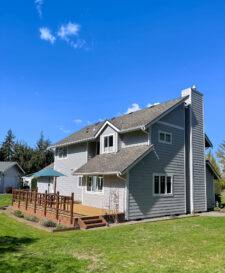
Signs a Lynden Home Needs Siding Repair, Not Just a Paint Job
Homeowners often call us about a spot that "just needs paint," and sometimes that's true. More often, discoloration is the first visible sign of something happening behind the surface. Here's what we look for, and what you can check yourself before calling anyone:
- Soft, spongy, or crumbling spots when you press on the siding, especially near the bottom courses or around window and door trim
- Persistent dark streaking or moss growth concentrated in one area rather than spread evenly across a wall
- Visible cracks or chips at butt joints, corners, or anywhere siding meets trim, flashing, or the foundation
- Bubbling, peeling, or bulging paint that comes back within a season or two of repainting
- Nail heads popping through the surface or fasteners that have rusted and stained the siding around them
- Gaps opening up at seams that weren't there when the siding was newly installed
- Interior signs that often get missed: musty smell near an exterior wall, a soft spot on interior drywall, or a slow-growing stain on a ceiling near an exterior corner
Any one of these on its own might be minor. Several together, especially clustered on the same wall, usually means water has been finding a way in for a while.
Cosmetic Damage vs. Structural Damage
Cosmetic damage — a scuff from a ladder, a hairline crack in a single board, fading on a sun-facing wall — is a straightforward, contained repair. Structural damage means water has reached the wood sheathing or framing behind the siding, and the repair has to address the water intrusion path first, then the visible siding second. Skipping that first step is the single most common reason a "repaired" spot fails again within a year or two.
What a Correct Siding Repair Actually Involves
A repair that holds up in this climate has to do more than fill a hole or swap a board. There's a sequence to it:
Diagnose Before You Patch
Before any siding comes off, we trace the damage back to its source. That means checking the flashing above windows and doors, looking at how the siding terminates at corners and the foundation line, and checking whether the original installation left adequate clearance and gapping. A patch placed over an unresolved water path just hides the problem for a season.
Match the Material and the Finish
Fiber cement siding is manufactured with specific profiles, exposures, and factory finishes. A repair patch cut from a different batch, a different plank width, or touched up with off-the-shelf paint instead of a color-matched finish will show as a visible seam for the life of the siding. Getting a repair invisible takes sourcing the right product, in the right profile, and finishing it correctly — not just finding "something close."
Rebuild the Water Management, Not Just the Surface
Correct repair work re-establishes proper lap and gapping, reseals joints with the right sealant (not just any exterior caulk), confirms flashing is doing its job, and restores clearance at grade and at any penetration points — hose bibs, vents, light fixtures — where water most often gets behind siding in the first place.
Repair or Replace? How We Help You Decide
Not every damaged section needs a full re-side, and not every "small" repair is actually small once you're behind the wall. We walk homeowners through this honestly rather than defaulting to whichever answer is more profitable for us.
| Factor | Repair Usually Makes Sense | Replacement Usually Makes Sense |
|---|---|---|
| Extent of damage | Isolated to one or two sections or a single wall | Recurring across multiple walls or found at several separate points |
| Underlying moisture | Source identified and fully resolvable at the repair site | Sheathing or framing damage found, or the source can't be isolated |
| Siding age and material | Existing fiber cement in good condition elsewhere on the home | Original siding is old wood, vinyl, or a discontinued composite nearing the end of its service life |
| Color and product match | Current product line still available for a close match | Discontinued color or profile that can't be matched without noticeable seams |
When we find damage that points to a bigger problem — widespread moisture intrusion, siding that's simply reached the end of its useful life — we'll tell you that plainly instead of stacking patch repairs on a wall that needs to come off.
Why We Repair to a Fiber Cement Standard
We install James Hardie fiber cement exclusively, and that shapes how we approach repair work too. When we're repairing existing Hardie siding — cracked plank, storm-damaged corner trim, a failed seam — we work with the manufacturer's repair specifications and ColorPlus-finished material so the patch performs and looks the way the rest of the wall does.
When a Lynden home still has older wood, vinyl, or a composite product like LP SmartSide, we'll still do honest repair work to buy time and stop active damage. But we won't pretend a patch on 20-year-old wood siding or a discontinued composite is a long-term fix. Those materials each carry their own maintenance burden and moisture sensitivity, and once a wall's damage is widespread rather than isolated, replacing with fiber cement is what actually solves the underlying problem for good — non-combustible, engineered for this region's wet-dry cycling, and backed by a strong factory finish warranty. We'll tell you when that point has been reached instead of running up repair bills on a wall that's due for real work.
Our Siding Repair Process
- Inspection. We walk the affected areas, check flashing and water paths, and probe for soft spots beyond what's visible.
- Diagnosis and honest options. We explain what we found, whether it's a contained repair or a sign of something larger, and what each option costs and involves.
- Material sourcing and color match. For fiber cement repairs, we source the correct profile and ColorPlus finish so the patch blends rather than stands out.
- Removal and water management rebuild. Damaged material comes off, sheathing is checked and repaired if needed, and flashing, gapping, and clearances are corrected before new siding goes back on.
- Finish and inspection. Fasteners, sealants, and finish work are completed to manufacturer spec, and we walk the repair with you before calling it done.
Why a Crew That Already Works in Lynden Matters
Siding repair is a trade where local familiarity actually changes the outcome. A crew that regularly works Whatcom County homes knows which walls in this climate tend to take the brunt of driving rain, where moss establishes fastest, and how quickly a small gap at a joint turns into real damage during a wet winter. That translates into faster, more accurate diagnosis and fewer surprises once a wall is opened up.
It also means practical things homeowners care about: a crew that can respond quickly after a wind or hail event instead of putting you on a weeks-long waiting list, one that already stocks or can quickly source the common Hardie profiles and colors used on homes in this area for a cleaner match, and one whose reputation depends on repairs that actually hold up through the next few wet seasons — not just look fine on the day the job wraps.
Keeping Repaired Siding Performing Long-Term
A good repair is only half the equation — the other half is keeping moisture from finding a new way in. A few habits go a long way in this climate:
- Rinse siding down at least once a year to keep moss and organic buildup from taking hold, especially on shaded, north-facing walls
- Keep gutters clear so overflow doesn't run down siding faces or pool at the base of a wall
- Trim back vegetation and maintain clearance between soil, mulch, or hardscaping and the bottom edge of the siding
- Recaulk around windows, doors, and penetrations if you notice cracking or gaps starting to form
- Have any new staining or soft spots checked promptly rather than waiting for it to spread
Fiber cement siding installed and repaired to spec is genuinely low-maintenance compared to what it's replacing, but "low-maintenance" isn't "no-maintenance" — a little attention each year keeps small issues from becoming wall-opening ones.
If you're seeing staining, cracking, or soft spots on your Lynden home's siding, we're glad to take a look and give you a straight answer on what it needs. Reach out for a free, no-pressure estimate — the form below gets you started.