 Sumas Window
 What Lynden's Climate Does to Siding
Lynden sits in the same wet, marine-influenced belt as the rest of Whatcom County, and homes here take a slow, steady beating from three things: salt-tinged air moving in off the Sound and the Strait, long stretches of driving rain that come sideways more often than straight down, and a moss season that can run eight or nine months a year on north- and west-facing walls. None of that is dramatic on any given day. It's the accumulation that gets people — caulk that dries out and cracks a season earlier than it should, paint that chalks and fades faster on the weather side of the house, and moss that gets a foothold in every seam and never really leaves.
Siding in this area isn't just a cosmetic choice. It's the first line of defense against a climate that stays damp for most of the year and only gets a short dry window in mid-summer to let anything dry out completely. Whatever goes on the wall needs to handle sustained moisture exposure, resist organic growth, and hold its finish without constant repainting — because repainting a house in a climate this wet is its own headache.
Why Fiber Cement Is the Right Call for This Area
We install exclusively James Hardie fiber cement siding, and we don't install vinyl, LP SmartSide, Cemplank, Allura, primed spruce, or cedar. That's not a marketing line — it's a decision we made after years of seeing how different materials actually hold up in Whatcom County weather, not how they perform in a manufacturer's brochure.
Wood-based products, including engineered wood and cedar, depend on an intact paint or sealant film to keep water out. In a climate where that film is under near-constant assault from rain and humidity, any breach — a nail pop, a hairline crack, a scuffed corner — gives moisture a path into the substrate. Once wood-based siding starts absorbing water, it swells, and swelling is the beginning of rot, no matter how good the product was on install day. Vinyl skips the rot risk but brings its own problems here: it expands and contracts with temperature swings, it can crack in a hard freeze, and it simply doesn't stand up to direct impact or long-term UV and salt exposure as well as a cement-based product.
Fiber cement is cement, sand, and cellulose fiber pressed and cured into a plank. It doesn't feed moss the way wood does, it doesn't warp, and because it's dimensionally stable, the caulk joints and paint film on top of it aren't being stretched and compressed every time the temperature swings. That stability is exactly what a wet, salt-air climate rewards.
What We Won't Do
We won't put a builder-grade vinyl product on a home in this area and call it a long-term fix, and we won't install primed wood siding that needs field-painting and annual caulk maintenance to survive. If a homeowner wants one of those products, that's their call — we just won't be the ones installing it, because we don't think it's the right material for what this climate does to a house over ten or twenty years.
What a Correct Fiber Cement Job Actually Involves
Fiber cement siding is only as good as its installation. A huge share of the "fiber cement problems" homeowners hear about trace back to installers treating it like vinyl or wood lap siding instead of following the manufacturer's actual specifications. Done right, here's what has to happen:
Clearances and Drainage
Siding needs a minimum clearance above roofing, decks, and grade — typically 6 inches from grade and 2 inches from roof surfaces — so splash-back and standing moisture don't wick into the bottom edge of the plank. In a rainfall-heavy area like this, that clearance is not optional; it's one of the first things we check on an older home during a tear-off.
Weather-Resistive Barrier and Flashing
Behind every board is a house wrap or weather-resistive barrier, and every penetration — windows, doors, vents, hose bibs — needs proper flashing integrated with that barrier so water is directed out, not into the wall cavity. This is where a lot of moisture problems actually originate, and it has nothing to do with the siding material itself.
Fastening and Joints
Hardie boards need to be fastened per the manufacturer's nailing pattern, with joints treated correctly — either caulked and sealed per spec or, on our jobs, run through H-joint or shadow-line detailing that keeps water from tracking behind the seam. Butt joints that are just tacked together without sealant are a common shortcut that shows up as staining and rot a few years down the line.
Factory Finish, Field-Touch-Up Only
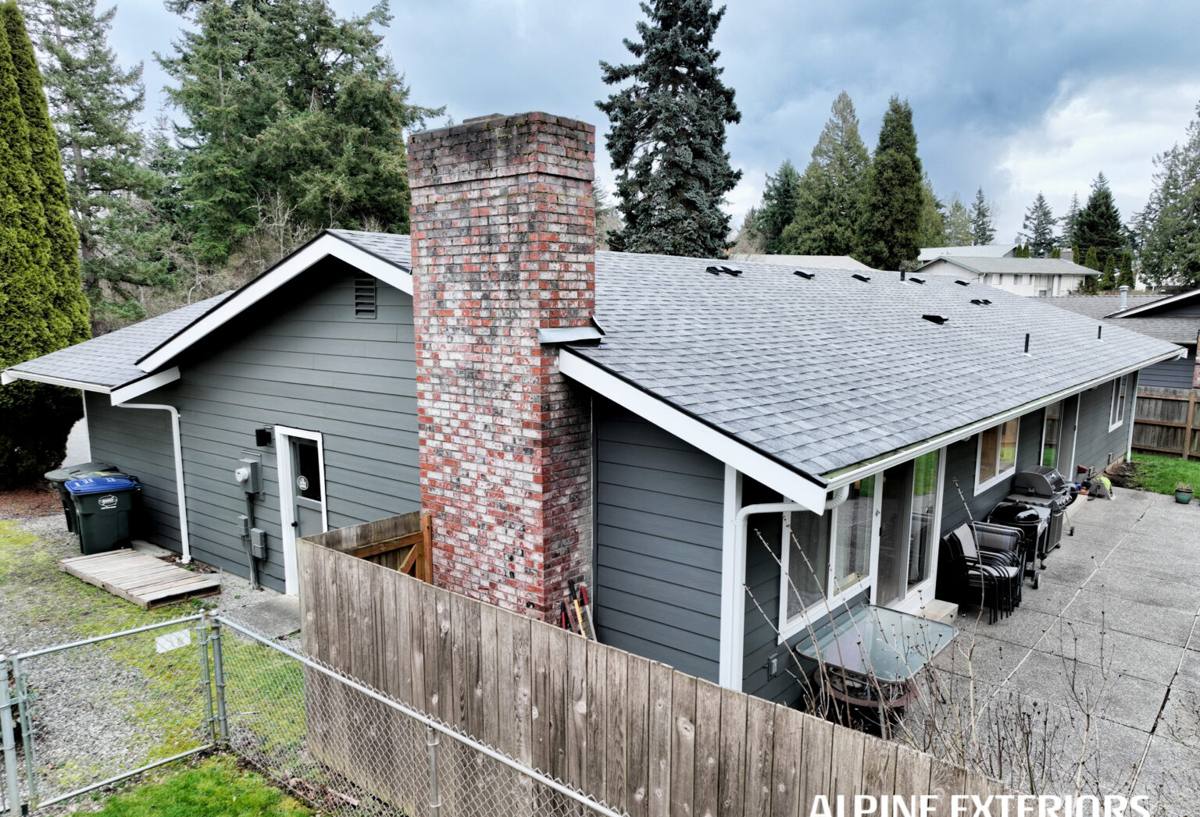
Because we install ColorPlus factory-finished Hardie boards, the color coat is baked on at the factory under controlled conditions, not brushed on at the job site. Field work is limited to touch-up at cut edges and fastener heads, using the matched touch-up kit. That's a meaningfully different (and more durable) process than field-painting an entire house, which is what wood siding demands.
The James Hardie Products We Use in This Area
James Hardie makes climate-engineered product lines, and for the Pacific Northwest we're typically specifying HZ5 boards, which are formulated for wetter, colder climates versus the HZ10 line built for hot, humid regions. That distinction matters — it's part of why we don't treat "fiber cement" as one generic product.
- HardiePlank lap siding — the most common choice for Lynden-area homes, available in several exposure widths and textures (smooth or cedar-shake style)
- HardiePanel vertical siding — used for board-and-batten looks or accent sections
- HardieTrim — matching trim boards so fascia, corners, and window surrounds age at the same rate as the field siding
- ColorPlus finishes — a factory-applied, baked-on finish backed by its own finish warranty, in a range of colors suited to the muted, natural palette common in this part of Whatcom County
Siding Options Compared for This Climate
| Material | Moisture Behavior | Maintenance | Typical Lifespan Here |
|---|---|---|---|
| Vinyl | Doesn't rot, but cracks under impact and stresses with temperature swings | Low, but hard to repair invisibly | 15–25 years |
| Cedar / primed wood | Absorbs moisture at any paint or caulk failure point | High — repaint and re-caulk on a recurring cycle | 10–20 years before major rot repair |
| LP SmartSide (engineered wood) | Better than raw wood but still depends on an intact seal at edges and cuts | Moderate — edge sealing and caulk checks matter | 20–30 years with diligent upkeep |
| James Hardie fiber cement | Dimensionally stable, doesn't swell or feed moss | Low — occasional wash, touch-up at cuts | 30+ years, per manufacturer warranty terms |
Our Process, Start to Finish
- On-site walk-through — we look at the existing siding, sheathing condition where visible, drainage clearances, and any trouble spots (moss buildup, past water staining, failed caulk joints)
- Written estimate — a clear scope covering tear-off (if needed), house wrap, flashing detail, board selection, trim, and color, with no vague allowances
- Tear-off and sheathing check — we don't cover up rot; if we find compromised sheathing, we flag it before closing the wall back up
- Weather barrier and flashing installation — the part of the job nobody sees but that determines whether the siding actually keeps water out
- Hardie board installation — per manufacturer fastening spec, correct clearances, proper joint treatment
- Trim, caulk, and touch-up — matched ColorPlus touch-up at cuts and fasteners
- Final walk-through — we go over the finished job with the homeowner before calling it done
Signs Your Current Siding Is Already Behind
- Moss or dark streaking that comes back within weeks of being washed off
- Caulk joints that have cracked, shrunk, or pulled away from trim and corners
- Soft or spongy spots when you press on the siding near the bottom courses
- Paint that's peeling or bubbling rather than just fading evenly
- Visible gaps at butt joints or around window and door trim
- Siding that flexes or feels hollow when tapped, a sign of moisture behind the surface
Common Problems We Find on Homes in This Area
The recurring issue we see on older homes here isn't usually the siding material itself — it's moisture management around it. Missing or poorly lapped flashing above windows, caulk used as a substitute for proper flashing, and clearances that got closed up over the years by landscaping or deck additions all show up repeatedly. Moss holding constant dampness against a wall doesn't cause rot on its own, but it keeps the surface wet for far longer stretches than an exposed wall would be, which accelerates whatever's already going wrong underneath. Part of a proper siding job in this climate is fixing those underlying issues, not just installing new boards over the same drainage problems.
What Affects the Cost of a Fiber Cement Job Here
| Cost Factor | Why It Matters |
|---|---|
| Tear-off vs. install over existing sheathing | Removing old siding and inspecting/repairing sheathing adds labor but avoids covering hidden problems |
| Home size and wall complexity | Dormers, multiple gables, and cut-up wall planes take more time per square foot than simple rectangular walls |
| Board profile and exposure width | Wider-exposure or textured (shake-style) boards cost more than standard smooth lap |
| Trim scope | Full HardieTrim replacement on corners, fascia, and window surrounds adds cost but keeps the whole exterior aging uniformly |
| Access and site conditions | Steep grades, limited staging area, or multi-story walls affect labor time |
Why It Matters That We Already Work This Area
A crew that's installed siding across Whatcom County knows what a Lynden-area wall actually needs before we even start pulling boards off — which clearances tend to be short on older builds, where moss holds on longest, and which flashing details get skipped most often by installers who aren't used to this specific climate. That's not something you can fully substitute with a general contractor from outside the region, no matter how skilled they are with the product in a drier climate. Installing James Hardie correctly in western Washington is a different job than installing it in Arizona, and we've built our process around the wet, salt-tinged, moss-prone conditions that define this part of the state.
Ready for a Straight Answer on Your Siding
If your current siding is showing moss, cracked caulk, or soft spots, or you're planning ahead for a replacement, we'll come look at it, tell you honestly what we see, and walk you through what a correct James Hardie installation would involve for your home. There's a form below for a free, no-pressure estimate.