 Sumas Window
 Why Ferndale's Climate Is Tough on Asphalt Shingle Roofs
Ferndale sits close enough to the water and to the marine air moving in off the Salish Sea that roofs here deal with a different set of stresses than roofs a few hours inland. Salt-laden air accelerates corrosion on exposed metal fasteners, flashing, and roof vents. Driving rain, especially in wind-driven storms common to Whatcom County, doesn't just fall straight down onto a roof — it pushes sideways and upward under shingle tabs, which is exactly where a poorly lapped underlayment or thin flashing detail fails first. And because the region rarely gets a hard, sustained freeze that would kill off organic growth, moss and lichen get a long season to establish themselves on any roof that holds moisture or shade.
None of this means asphalt shingles are a bad choice for Ferndale. They remain one of the most practical, cost-effective roofing materials for this climate when the installation accounts for these specific pressures. The problems we get called out for almost always trace back to shortcuts taken during the original install, not a flaw in the shingle itself.
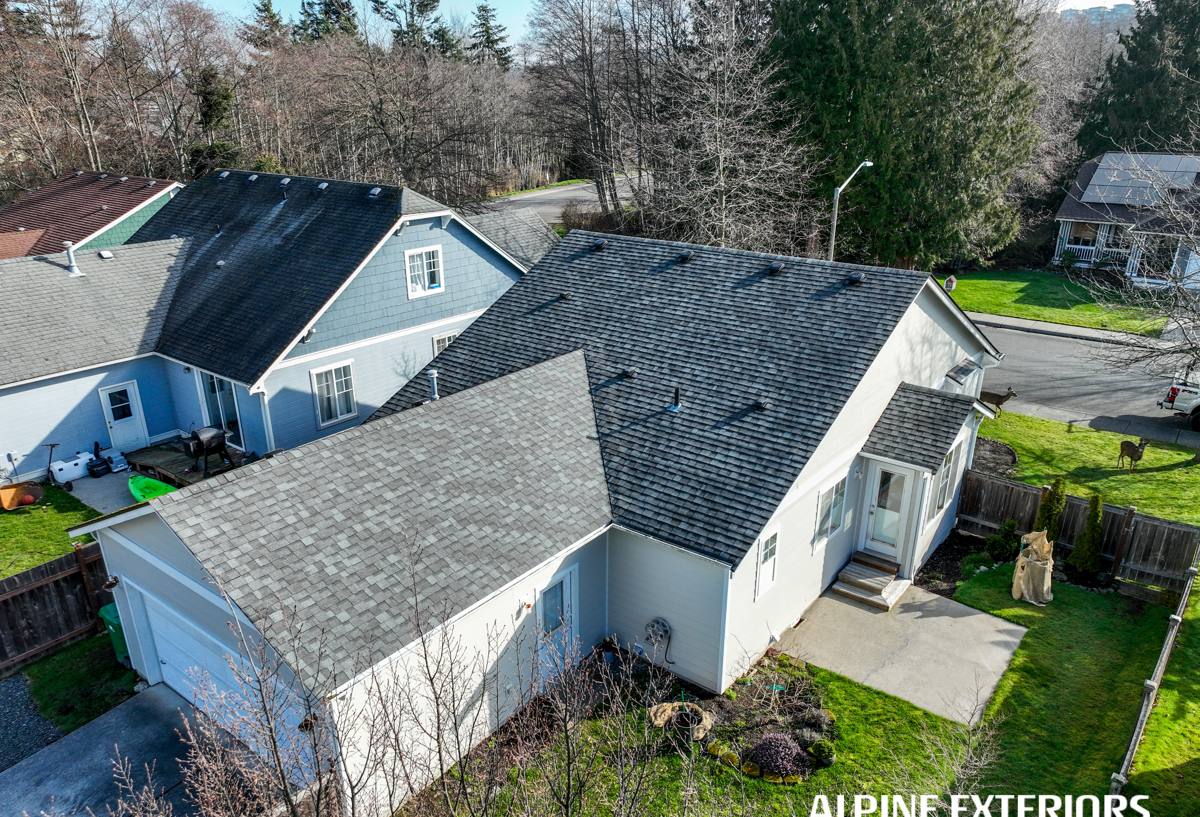
What a Correctly Installed Shingle Roof Actually Includes
A shingle roof is a system, not a single product. The shingle is the visible layer, but the layers underneath and the details around penetrations do most of the work keeping water out over the life of the roof.
Underlayment and Water Protection
In a climate with this much sustained rain, we treat underlayment as load-bearing protection, not an afterthought. A synthetic underlayment with properly lapped seams gives a second line of defense if wind or ice ever drives water past the shingle surface. Along eaves and valleys, where water concentrates and moves fastest, an ice-and-water shield membrane is worth the extra material cost even though this area doesn't see the deep freeze-thaw cycles that make it mandatory elsewhere.
Ventilation
Attics that can't breathe trap moisture, and trapped moisture shortens the life of the roof deck from underneath — often before the shingles themselves show any wear. A balanced system of intake at the eaves and exhaust at the ridge keeps warm, moist air moving out instead of condensing on the underside of the sheathing. This matters more in a wet climate than a dry one, because there's less margin for a mistake to dry out on its own between storms.
Flashing at Every Penetration
Chimneys, skylights, plumbing vents, and any wall-to-roof transition are where the vast majority of shingle roof leaks actually originate — not in the open field of shingles. Step flashing, counter-flashing, and properly sealed pipe boots need to be installed as separate metal components integrated with the shingle courses, not just caulked over. Caulk is a maintenance item; correctly lapped metal is a permanent detail.
Signs a Ferndale Roof Needs Attention
- Granules collecting in gutters or at downspout outlets — a sign shingles are wearing past their protective layer
- Dark streaking or thick moss patches, especially on north-facing slopes that stay shaded and damp longer
- Curling, cupping, or lifted shingle edges, often worse on slopes that catch the most wind-driven rain
- Rusty streaks below metal flashing or vent boots, a sign the metal itself is starting to corrode
- Soft spots, staining, or a faint musty smell in the attic, which usually points to a slow leak that's been running longer than any ceiling stain suggests
- Daylight visible around chimney or skylight flashing from inside the attic
Any one of these is worth a look before it becomes a bigger repair. Roofs rarely fail all at once — they fail one detail at a time, and the detail is usually a flashing point or a ventilation gap, not the shingle field itself.
Choosing the Right Shingle for This Climate
Not every asphalt shingle is built the same way, and the differences matter more in a wet, salt-air climate than they would somewhere drier. The table below is a general comparison — actual products and warranties vary by manufacturer.
| Shingle Type | Typical Lifespan | How It Handles This Climate |
|---|---|---|
| 3-tab (builder grade) | 15–20 years | Lowest upfront cost; thinner profile is more vulnerable to wind lift and shows wear from moss and moisture faster |
| Architectural / dimensional | 25–30 years | Heavier, laminated construction resists wind uplift better and sheds water more effectively at overlaps |
| Algae-resistant (AR) shingles | 25–30+ years | Copper- or zinc-infused granules slow moss and algae growth, useful on shaded or north-facing roof planes |
| Premium / designer | 30–50 years | Best wind and impact ratings, thickest profile, highest material cost — worth it on exposed or high-visibility roofs |
For most Ferndale homes, we lean toward architectural shingles with algae-resistant granules as the practical middle ground — they hold up to wind-driven rain better than 3-tab shingles and slow down the moss cycle that's otherwise a near-constant battle in this area.
Our Process for Ferndale Roofing Projects
- On-site inspection. We walk the roof and the attic, not just look from the ground, so we can see the actual condition of the deck, flashing, and ventilation before quoting anything.
- Honest scope. We tell you what needs to happen now versus what can reasonably wait, and we explain why — no upselling a full tear-off when a targeted repair or partial re-roof will do the job.
- Deck check during tear-off. Once the old shingles come off, we inspect the sheathing for soft spots or rot before anything new goes down. Bad decking gets replaced, not covered over.
- Underlayment, ice-and-water shield, and flashing installed to spec. These layers get the same attention as the visible shingles, since they're what actually keeps water out long-term.
- Ventilation review. We make sure intake and exhaust are balanced for the attic space, adjusting vents where the existing setup falls short.
- Final walk-through. We go over the finished roof with you, including care and maintenance specific to your property's exposure and tree cover.
Maintenance: Staying Ahead of Moss and Salt Air
A well-installed roof still needs some upkeep in this climate, and the maintenance that matters most here is different from what a drier region would need.
- Clear gutters and downspouts at least twice a year so water isn't backing up under the shingle edge
- Trim back overhanging branches to cut down on shade and debris, which are the two biggest drivers of moss growth
- Have moss physically removed rather than pressure-washed off — high-pressure water can drive granules loose and force moisture under shingle tabs
- Check exposed metal flashing and vent boots periodically for early rust or corrosion, especially after storm season
- Address small leaks or attic moisture right away — in this climate, a slow drip has months to do damage before a dry season gives it a break
Cost Factors for Ferndale Roofing Projects
Every roof is different, but the same handful of factors drive most of the price variation we see on quotes in this area.
| Factor | Why It Affects Cost |
|---|---|
| Roof size and pitch | Steeper roofs take longer and require more safety setup; larger roofs need more material and labor |
| Number of penetrations | Each chimney, skylight, or vent needs individual flashing work, which adds labor time |
| Deck condition | Rotted or soft sheathing found during tear-off needs replacement before new roofing goes down |
| Shingle tier chosen | Material cost scales with wind rating, warranty length, and algae resistance |
| Tear-off vs. layover | Removing old layers costs more upfront but is the only way to properly inspect and repair the deck |
| Access and site conditions | Tree cover, steep lots, or limited staging space can add time to the job |
We give a written scope with the quote so you can see exactly what's driving the price, rather than a single lump number.
Why Local Experience in Ferndale Matters
A roofing crew that's worked around Ferndale and the rest of Whatcom County already knows which slopes tend to hold moss, how far wind-driven rain can push water under a poorly flashed detail, and what the salt air off the water does to unprotected metal over time. That's the kind of judgment that doesn't come from a spec sheet — it comes from having stood on enough local roofs to see the same failure patterns repeat. It also means we're not guessing at permit requirements or inspection expectations for the area; we know what the county and local building departments actually look for.
If you'd like a straightforward look at your roof's condition, we're happy to come take a look. There's no pressure and no obligation — just a clear read on where things stand and what, if anything, needs to happen next. Use the form below to request a free estimate.