 Sumas Window
 Why Board & Batten Behaves Differently in Everson's Climate
Board and batten siding is a vertical cladding style — wide panels or boards installed vertically, with narrower strips (battens) covering the seams between them. It's a look a lot of Everson homeowners want: clean lines, a farmhouse or craftsman feel, and strong shadow lines that read well against the Nooksack Valley's tree lines and open farmland. But the same vertical orientation that makes it attractive also changes how water moves across the wall compared to standard horizontal lap siding.
Whatcom County's climate is hard on any cladding, but it's particularly unforgiving of siding systems with more seams and more butt joints. Driving rain off the valley pushes water sideways into wall assemblies, not just down. Salt-tinged marine air moving inland keeps humidity elevated for long stretches of the year. And a long moss season — often eight months or more of the right combination of shade, moisture, and cool temperatures — means anything that traps water against a wall, or gives moss a foothold on a rough or unsealed surface, will show it within a couple of seasons. On a house near Everson, that usually shows up first on north- and west-facing walls, under eaves with limited overhang, and at the base of walls near grade.
None of that means board and batten is a poor choice here. It means it has to be installed as a system, not just fastened up and caulked. The battens, the panel seams, the starter course, and the flashing details all have to work together to keep water moving out and down, not into the wall cavity.
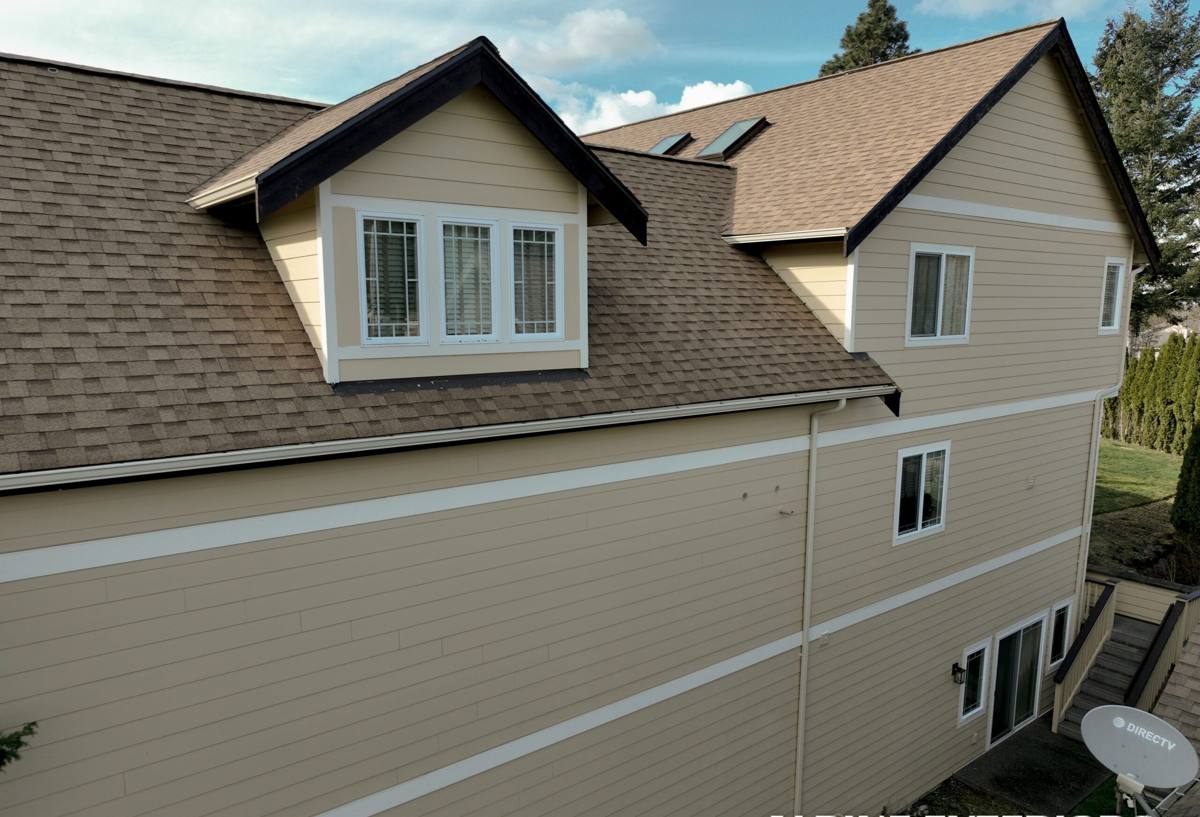
What a Correct Board & Batten Installation Actually Involves
The Drainage Plane Comes First
Before a single panel goes up, the wall needs a proper weather-resistant barrier and, in most cases on our jobs, a rainscreen gap behind the siding. That gap gives any moisture that gets past the cladding a path to drain and dry out instead of sitting against the sheathing. In a climate with this much sustained rain, skipping the rainscreen is one of the most common shortcuts that leads to hidden rot years down the road — long after the siding still looks fine from the curb.
Fastening and Batten Spacing
Board and batten only performs as designed when fasteners are placed exactly where the manufacturer specifies, battens overlap panel seams by the correct margin, and panels are allowed the clearance they need at the bottom to avoid wicking moisture up from grade or a deck ledger. Get the spacing wrong and you either starve the panel of the room it needs, or leave a seam gap wide enough for wind-driven rain to find.
Flashing at Every Penetration
Every window, hose bib, light fixture, and vent penetrating a board and batten wall needs its own flashing detail. Because the battens create a visually busy surface, it's tempting for a less careful crew to rely on caulk alone to seal around penetrations. Caulk is a maintenance item, not a waterproofing strategy — it degrades and needs to be renewed. Proper flashing does the structural work of keeping water out; sealant is the backup, not the primary defense.
James Hardie's Board & Batten System: What We Actually Install
We install James Hardie fiber cement exclusively, and board and batten is one of the styles where that decision matters most. Hardie's system for this look pairs vertical HardiePanel siding with Hardie trim boards used as battens, all factory-finished with ColorPlus Technology so the color is baked on before the material ever reaches Everson — not brushed on in the field after installation.
A few specifics worth knowing:
- Non-combustible core: fiber cement doesn't feed a fire the way wood-based or vinyl products can, which matters for insurance conversations as much as safety.
- Climate-matched formulation: James Hardie manufactures different product formulations for different regions. Homes in our part of Washington are specified using the formulation engineered for higher-moisture, marine-influenced climates, rather than a one-size-fits-all product.
- Factory finish: ColorPlus color is baked on and warranted separately from the substrate warranty, so you're not relying on field-applied paint to hold up through a Whatcom County winter.
- Dimensionally stable: fiber cement doesn't swell and shrink with moisture the way engineered wood products can, which matters a great deal at the seams and joints board and batten depends on.
We get asked fairly often why we don't offer LP SmartSide or vinyl board and batten as a lower-cost alternative. Both are legitimate products with real strengths — LP SmartSide is lighter and easier to handle, vinyl is inexpensive and low-maintenance in mild climates. Our concern isn't that either product is defective; it's that engineered wood siding depends on its factory edge-seal staying intact at every field cut, and vinyl board and batten profiles can show heat distortion and don't hold color the way a baked-on finish does. In a climate that gives siding this many wet months to find a weakness, we'd rather stand behind one system we can install to spec every time than manage the trade-offs of several.
Our Process for Board & Batten Projects Near Everson
- Site evaluation: we walk the exterior, check existing sheathing and moisture conditions, and look specifically at the walls most exposed to driving rain and shade-driven moss growth.
- Product and reveal selection: panel width, batten spacing, and ColorPlus color are chosen together, since reveal size affects both the look and the water-shedding performance.
- Tear-off and substrate check: old siding comes off and the sheathing underneath gets inspected before anything new goes up — this is where hidden problems from a prior installation usually surface.
- Weather barrier and rainscreen installation: the drainage plane goes in before any cladding, sized and detailed for the wall assembly in question.
- Panel and batten installation: installed to James Hardie's published fastening schedule and reveal specifications, not "close enough."
- Flashing, trim, and detail work: windows, penetrations, and terminations get proper flashing rather than relying on caulk.
- Final walk-through: we go over the finished wall with you before calling the job done.
What Board & Batten Costs in Everson
Board and batten typically runs somewhat higher than standard lap siding on the same home, mostly because of the added batten material and the extra labor of installing two components instead of one. The table below covers the main factors that move the price on a given project — we'll walk through your specific numbers during a free estimate.
| Cost Factor | Why It Matters |
|---|---|
| Home size and wall complexity | More corners, gables, and dormers mean more batten cuts and flashing details |
| Existing siding removal | Tear-off and sheathing repair add labor before new siding can go up |
| Batten spacing and reveal choice | Narrower spacing uses more material and more fastening labor per square foot |
| Trim and corner detailing | Board and batten shows more trim per wall than lap siding, and detailing takes time to do right |
| Rainscreen/drainage plane | Adds material and labor but is not optional in this climate if you want the wall to last |
| Site access | Two-story walls, tight lot lines, or limited equipment access affect labor time |
Common Board & Batten Mistakes We See (and Avoid)
Board and batten is forgiving to look at and unforgiving to install poorly. The mistakes we run into most often on homes we're asked to repair or re-side near Everson:
- No rainscreen gap, leaving moisture trapped directly against the sheathing
- Battens fastened directly through both layers into panel seams instead of independently, which restricts natural movement
- Inconsistent batten overlap that leaves gaps wide enough for wind-driven rain
- Field-cut panel edges left unsealed, allowing moisture into the substrate at cut ends
- Caulk used as the primary seal around windows and penetrations instead of proper flashing
- Panels installed too close to grade, a deck, or a roofline, wicking moisture from below
Maintenance Checklist for Board & Batten Homes
Fiber cement is low-maintenance, not no-maintenance. A short annual check goes a long way in a climate like ours:
- Walk the exterior once a year and look for moss starting on north-facing walls or under deep eaves
- Check caulk joints around windows, doors, and penetrations for cracking or separation
- Keep gutters clear so overflow isn't running down the wall face
- Trim back shrubs and trees that keep a wall shaded and damp longer than it needs to be
- Look for staining or darkening at the bottom few inches of panels near grade, decks, or walkways
- If touch-up paint is ever needed, use a product compatible with ColorPlus finish rather than any generic exterior paint
Why a Crew That Already Works in Everson Matters
A lot of siding problems in this area aren't installation errors in the obvious sense — they're a correct installation for the wrong climate. A crew that mostly works drier parts of the state may not think twice about skipping a rainscreen or being casual about batten overlap, because in their normal conditions it rarely bites them. In Whatcom County, with this much sustained rain, salt-influenced air, and moss pressure, those shortcuts show up. Working in and around Sumas and Everson regularly means we're not guessing at how a wall assembly will hold up here — we're seeing the results on houses a few miles apart, in every season, year after year.
If you're weighing board and batten for a home near Everson, we're happy to take a look and give you a straight answer on what your walls need — no pressure, no obligation. Reach out for a free estimate using the form below.