 Sumas Window
 Roofing in Clearbrook, BC: What the Climate Actually Demands
Clearbrook sits in the Fraser Valley, close enough to the coast that homes here deal with a version of weather that's harder on a roof than most inland climates ever see. Salt-tinged marine air moves in off the water and works its way into fasteners, flashing seams, and any exposed metal. Add driving, wind-pushed rain that doesn't fall straight down but gets forced sideways under shingle tabs and around vent boots, and you've got a climate that finds every weak point in a roofing system within a few seasons. Then there's moss. The combination of shade from mature trees, persistent damp, and mild winters gives moss a long growing window here — often eight months or more out of the year in shaded, north-facing sections of a roof.
None of this means a roof in Clearbrook needs to be exotic or over-built. It means the ordinary things — underlayment quality, flashing detail, ventilation, and moss prevention — matter more here than they would in a drier climate, and cutting corners on any of them shows up faster than homeowners expect.
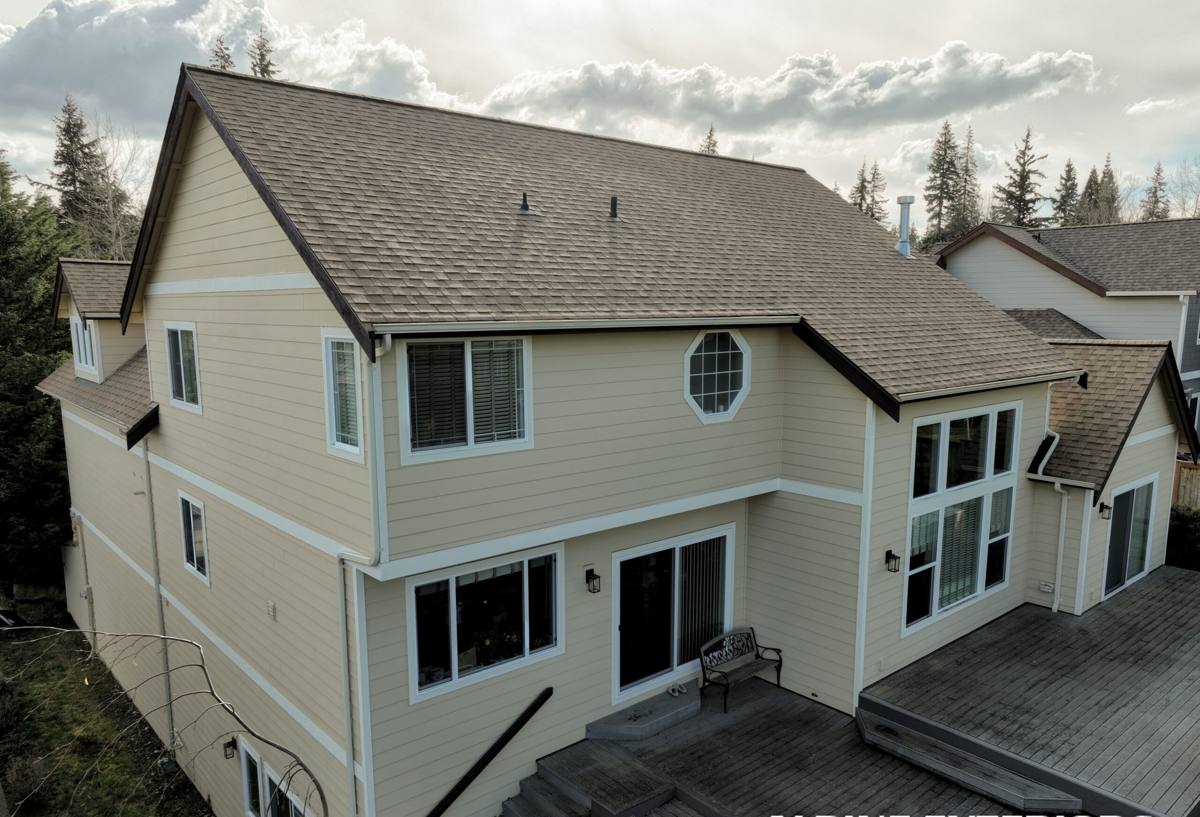
Signs a Clearbrook Roof Needs Replacing, Not Just Repairing
Not every roof problem calls for a full replacement, and a straightforward contractor should tell you that up front. But there's a point where patching becomes a losing game — you're spending money to buy a few more months on a roof that's already failing underneath. Here's what usually tips a roof from "repairable" to "replace":
- Granule loss heavy enough that you can see bare asphalt on multiple shingles, not just a few isolated spots
- Shingles that are cupping, curling, or cracking across large sections rather than one localized area
- Moss that has worked its way under shingle edges and is lifting them, not just sitting on the surface
- Soft or spongy decking felt underfoot in the attic, or daylight visible through the roof deck
- Repeated leaks in different spots each year, rather than one recurring leak at a single flashing point
- A roof at or past the manufacturer's expected service life for its material, especially if it was installed with lower-grade materials or minimal ventilation
If a roof is showing one or two of these signs isolated to a small area, a repair is often the honest answer. When several show up at once, or the underlying decking is compromised, replacement is usually the more cost-effective path — repeated repairs on a failing roof rarely pencil out over a two- or three-year window.
What a Correct Roof Replacement Involves
A roof replacement done right is not just stripping old shingles and nailing down new ones. In a climate like this one, the parts you don't see matter as much as the parts you do:
Tear-off and deck inspection
Full tear-off to the deck lets us actually see what's underneath — rot, delamination, or soft spots that a re-roof over old material would simply bury. Any damaged decking gets replaced before anything new goes down, because new shingles fastened to a weak deck will fail early no matter how good the shingle is.
Underlayment and ice-and-water protection
Given how much wind-driven rain this area sees, underlayment isn't a place to save money. Synthetic underlayment with self-adhering ice-and-water membrane at eaves, valleys, and around penetrations gives the roof a second line of defense when wind pushes rain up under the shingle tabs — which happens here more than most homeowners realize.
Flashing
Flashing around chimneys, skylights, sidewalls, and vent pipes is where most roof leaks actually originate — not the field of the roof itself. New flashing, properly stepped and sealed rather than just caulked over old metal, is non-negotiable on a proper replacement.
Ventilation
A roof that can't breathe traps moisture in the attic, which shortens shingle life from underneath and feeds condensation problems. Balanced intake and exhaust ventilation should be part of every replacement, not an upsell.
Moss-resistant details
On shaded slopes, we look at whether zinc or copper strips near the ridge make sense to slow moss regrowth, and we make sure valleys and low-slope transitions are detailed so water and debris don't pool and feed moss colonies right after the new roof goes on.
Material Options for Fraser Valley Homes
There's no single "best" roofing material — the right choice depends on the home's exposure, budget, and how much upkeep the owner wants to do. Here's how the common options stack up for this climate specifically:
| Material | How it handles this climate | Typical service life | Maintenance burden |
|---|---|---|---|
| Architectural asphalt shingle | Solid performance with proper underlayment and flashing; needs periodic moss treatment on shaded slopes | 25-30 years | Moderate — moss checks, gutter clearing |
| Metal (standing seam or panel) | Sheds moss and rain well due to slick surface and steep-shed profile; fasteners and cut edges need corrosion-resistant treatment near salt air | 40-50+ years | Low, once installed correctly |
| Cedar shake | Traditional look but holds moisture longer, which accelerates moss and rot risk in this climate without diligent upkeep | 20-30 years with upkeep | High — regular treatment and inspection |
| Synthetic/composite shingle | Resists moisture absorption better than wood, holds up to driving rain well | 30-50 years | Low to moderate |
For most homes in the area, a well-installed architectural asphalt or a metal roof offers the best balance of upfront cost and long-term performance against this specific mix of rain, salt air, and moss. We'll walk through the honest trade-offs for your roof's exposure and slope rather than pushing one product across the board.
Our Roof Replacement Process
We keep the process predictable because a roof job is disruptive enough without surprises added on top:
- On-site inspection. We get on the roof (or use a drone where access is limited) and check decking, flashing, ventilation, and moss condition — not just a look from the ground.
- Written estimate. A clear scope of work and price, broken down so you know what you're paying for — tear-off, decking repair if needed, underlayment, materials, flashing, and cleanup.
- Material selection. We go over the options that fit your home's exposure and budget, including how each performs against moss and driving rain specifically.
- Scheduling around weather. Roof replacement needs a dry work window. We watch the forecast and schedule accordingly rather than rushing a job into a wet stretch.
- Tear-off and deck repair. Full removal of old roofing, inspection and repair of the deck, and correction of any ventilation issues found underneath.
- Installation. New underlayment, flashing, and roofing material installed to manufacturer spec, with extra attention to valleys, eaves, and any north-facing or shaded slopes.
- Final walkthrough and cleanup. Magnetic sweep for nails, full site cleanup, and a walkthrough so you can see the finished work before we call the job done.
Why a Crew That Already Works Clearbrook Matters
Sumas Window Co is based just across the border in Sumas, Washington, and Clearbrook is close enough that it's part of our regular service area — not a special trip. That matters for a few practical reasons. First, we already know how this specific stretch of the Fraser Valley's weather behaves: which slopes hold moss longest, how far wind-driven rain pushes under a shingle edge in a fall storm, and which flashing details tend to fail first in homes built decades apart. Second, working both sides of the border regularly means we're used to coordinating logistics — scheduling, material delivery, and permitting requirements — without treating your project as an exception that adds delay or confusion. And third, a crew that's back in the same area repeatedly has a reputation to protect locally; that's a real incentive to do the job right the first time rather than move on and hope no one calls back.
We're straightforward about scope and pricing, and we don't recommend a full replacement when a repair will genuinely hold up — the goal is a roof that performs for its full expected life, not a bigger invoice.
Roof Replacement Cost Factors
Every roof is different, but the same handful of factors drive most of the cost variation we see on jobs in this area:
| Factor | Why it affects cost |
|---|---|
| Roof size and pitch | Steeper roofs take longer to work safely and need more fall-protection setup |
| Number of layers to remove | Tearing off multiple old layers costs more in labor and disposal than a single layer |
| Decking condition | Rotted or soft decking sections need replacement before new roofing can go down |
| Material choice | Asphalt, metal, and composite materials carry different material and labor costs |
| Roof complexity | Valleys, dormers, chimneys, and skylights all add flashing work and time |
| Access | Steep lots, limited driveway access, or tall roofs affect equipment and labor time |
Because these factors vary so much house to house, we don't quote sight-unseen. A short on-site look lets us give you a number that actually holds once the work starts, instead of a low estimate that grows once the crew is on the roof.
Maintaining Your New Roof Through Moss Season
A new roof still needs a little seasonal attention here, especially on shaded slopes. Keeping gutters clear so water doesn't back up under the eaves, trimming back overhanging branches that keep a slope damp and shaded, and having moss treated or gently removed before it works under shingle edges will all extend the life of a new roof considerably. We're happy to point out which slopes on your specific home are most exposed and what a reasonable maintenance schedule looks like — it's a short conversation that saves real money over the life of the roof.
If your Clearbrook roof is showing wear, or you'd just like an honest read on whether it's a repair or a replacement situation, we're glad to come take a look. The estimate is free, there's no pressure, and you'll get a straight answer either way.