 Sumas Window
 Blaine's Climate Is Rougher on Siding Than It Looks
Blaine sits right on the water, tucked against Semiahmoo Bay and the Canadian border at the top of Whatcom County. That location is part of what makes it a great place to live, and it's also exactly why siding fails faster there than it does twenty miles inland. Homes close to the shoreline take on salt-laden air that settles into every seam, fastener, and unsealed edge of a wall assembly. Add driving rain that comes in sideways off the Strait during fall and winter storms, and a moss season that can run eight months out of the year in shaded, damp yards, and you've got three separate stresses working on the same wall at the same time.
None of those three problems are dealt with by picking a siding color you like and nailing it up. They're dealt with by choosing a material that doesn't rot, swell, or corrode under sustained moisture, and then installing it in a way that keeps water moving out and away from the wall instead of sitting against it. That's the whole conversation on this page.
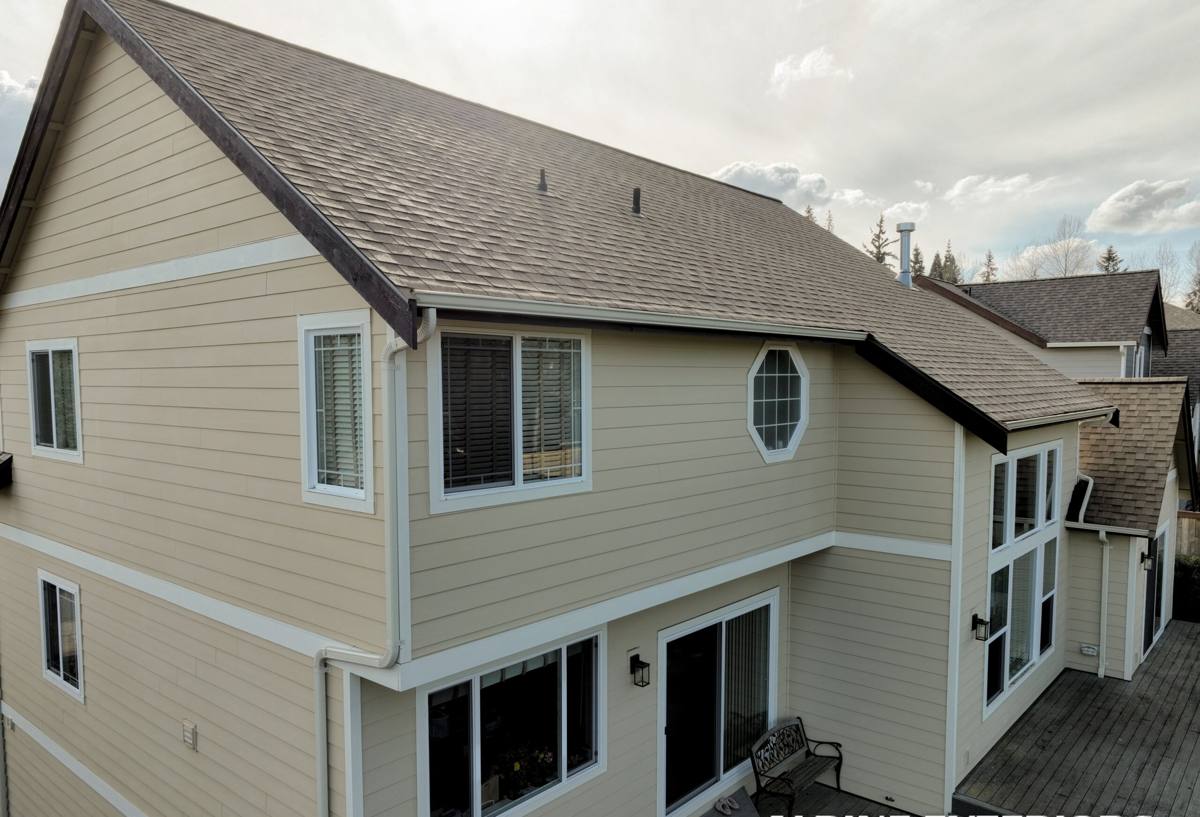
Why We Only Install James Hardie on Blaine Homes
We don't install LP SmartSide, vinyl, Cemplank, Allura, primed spruce, or cedar. That's not a marketing line — it's a standard we set after years of seeing which products actually hold up in this corner of Washington and which ones need constant attention to survive it. Wood-based sidings, no matter how well engineered the coating, still have a wood substrate underneath. In a salt-air, high-rainfall environment, that substrate is the weak point: moisture finds the cut ends, the fastener holes, the field damage, and once it's in, the clock starts on rot. Vinyl doesn't rot, but it moves with temperature swings, discolors under UV and salt exposure over the years, and can't be repainted when it fades — you replace it.
James Hardie fiber cement is cement, sand, and cellulose fiber. There's no organic material for moisture to break down, and it doesn't combust. Hardie also builds region-specific formulations under its HZ product system, and the HZ10 line is engineered specifically for the wetter, milder climate zone that includes coastal Whatcom County — it's built to handle sustained moisture exposure and freeze-thaw cycling without the swelling or cracking you'd get from a product designed for a drier climate. For a house exposed to salt air and driving rain a good part of the year, that's the difference between siding that needs to be watched and siding you can stop thinking about.
ColorPlus Finish Matters More Here, Not Less
Field-painted siding near the coast takes a beating from salt and UV, and repainting a full exterior every five to seven years is a real, recurring cost most homeowners underestimate when they're pricing a job. Hardie's ColorPlus finish is baked on at the factory in multiple coats under controlled conditions, not brushed on in a driveway. It holds color and resists fading far longer than field-applied paint, and it comes with its own finish warranty separate from the product warranty. In a salt-air environment that's actively working to strip color and break down coatings, that factory finish is doing real work, not just adding convenience.
What a Correct Installation Involves
Fiber cement siding is only as good as the wall assembly behind it. We've seen Hardie products installed poorly — nailed tight against sheathing with no drainage plane, caulked instead of flashed, face-nailed with the wrong fastener — and those installs fail for reasons that have nothing to do with the material. A correct job on a Blaine home includes:
- A weather-resistive barrier installed and lapped correctly, with all penetrations properly flashed before siding goes on
- A rainscreen gap (typically a drainage mat or furring strips) so bulk water and incidental moisture behind the cladding can actually drain and the wall can dry out between rain events
- Corrosion-resistant fasteners — stainless steel is worth the upgrade cost this close to salt water, since standard galvanized fasteners can streak and corrode over time in this exposure
- Correct nail placement and spacing per Hardie's published fastening schedule, not "close enough"
- Factory-caulked or properly sealed joints at every butt seam, corner, and penetration, using sealant rated for the exposure
- Proper clearance at grade, decks, and roof lines so siding doesn't wick moisture from standing water or trapped debris
Skip any one of these and you can still end up with moisture problems behind fiber cement siding — the material itself won't rot, but trapped water behind it can damage sheathing, framing, and insulation. The siding is only one layer of a system; the installation is what makes that system actually shed water the way it's designed to.
Product Lines That Make Sense for Blaine Homes
Hardie makes several siding profiles, and the right one depends on the home's style and exposure, not just preference.
| Product | Best Use | Why It Fits Here |
|---|---|---|
| HardiePlank lap siding | Most home styles, horizontal reveal | Most common choice; wide range of textures and exposures, straightforward water-shedding lap design |
| HardiePanel vertical siding | Modern styles, accent walls, gable ends | Fewer horizontal seams for water to catch on exposed gable faces |
| HardieShingle | Craftsman and cottage-style homes | Traditional look without the moisture sensitivity of real wood shingles under sustained coastal dampness |
| HardieTrim boards | Corners, window and door trim, fascia | Matches the fiber cement performance of the field siding instead of mixing in wood trim that rots first |
We'll walk through which combination fits your home's design and exposure during the estimate — a house facing the water full-time may warrant different detailing than one set back and shielded by trees or neighboring structures.
Living With Moss Season Once the Siding Is Up
Moss doesn't grow on the siding material itself so much as on grime, pollen, and organic debris that collects on any exterior surface in a shaded, damp yard. Fiber cement doesn't feed moss growth the way wood can once a coating starts to fail, but it still needs occasional attention:
- A gentle wash once or twice a year (garden hose and soft brush, or a low-pressure rinse) keeps organic buildup from taking hold, especially on north-facing walls and anything under tree cover
- Keep gutters clear — overflow during heavy rain is one of the most common causes of streaking and localized moss growth right below the roofline
- Trim back vegetation that keeps a wall section shaded and damp long after the rest of the house has dried out
- Avoid high-pressure washing directly at seams and joints — it can drive water where it doesn't belong even on well-installed siding
None of this is heavy maintenance. It's the same light upkeep any exterior needs in a marine climate — it's just more forgiving with a material and finish that isn't already fighting rot or fade underneath.
Our Process for Blaine Jobs
- On-site assessment — we look at wall exposure, existing moisture damage, current siding condition, and how the home sits relative to prevailing wind and rain direction
- Tear-off and inspection — once old siding comes off, we check sheathing and framing for hidden moisture damage before anything new goes on; this is often where old wood or vinyl siding was hiding problems
- Water management installed first — barrier, flashing, and rainscreen components go in and get inspected before a single piece of Hardie siding is hung
- Siding installation to Hardie's fastening and clearance specs — not generic best practice, the manufacturer's actual published requirements, which is also what keeps the product warranty intact
- Final walkthrough — trim, caulking, and touch-up finish checked before we call the job done
Working in Blaine regularly means we already know which parts of town see the harshest wind-driven rain, which lots hold shade and moisture longest, and which older homes in the area are more likely to have hidden moisture damage under their existing siding before we ever pull the first board. That's not something a crew coming from outside the area picks up on the first visit — it changes how carefully we look at flashing details and drainage on the first walkthrough.
What Affects the Cost of a Blaine Siding Job
| Factor | Why It Matters |
|---|---|
| Tear-off vs. new construction | Removing and disposing of old siding, plus repairing any hidden sheathing damage, adds labor and material cost |
| Home size and wall complexity | More corners, gables, and dormers mean more cutting, flashing, and trim work |
| Product line and profile | HZ10 and specialty profiles like shingle-style siding cost more than standard plank |
| Fastener upgrade | Stainless steel fasteners cost more than standard but resist corrosion far better this close to salt water |
| Access and site conditions | Steep lots, tight setbacks, or limited equipment access near the water can add time |
We give real numbers during the estimate walkthrough, not a phone quote — every home's exposure and existing condition is different enough that a number given without seeing the house isn't useful to you.
Questions Worth Asking Any Siding Contractor
- Do you install a drainage plane or rainscreen behind the siding, or does it go directly against the barrier?
- What fastener type do you use, and is it upgraded for coastal exposure?
- Are you a certified James Hardie installer, and does that affect the warranty coverage?
- How do you handle flashing at windows, doors, and roof intersections?
- What does your workmanship warranty cover, separate from the manufacturer's product warranty?
- Can you show me the fastening schedule you're following and how it matches Hardie's published specs?
Any contractor confident in their work should be able to answer these without hesitation. If the answer to the drainage plane question is a blank stare, that's worth noting.
Why Local Experience in Blaine Specifically Matters
Whatcom County isn't one climate — the difference between an inland Sumas job and a Blaine job right on the water is real, and it shows up in how much attention flashing, fastener choice, and drainage detailing need. A crew that already works this stretch of coastline has seen which details hold up over years of salt air and driving rain and which ones cause callbacks. That's not something a spec sheet tells you; it's something you learn from doing the work here repeatedly.
If you're weighing a siding replacement or repair on a Blaine home, we're happy to walk the property, look at what's there now, and talk through what James Hardie's product lines would look like on your house — no pressure, no obligation. Use the form below to request a free estimate.