 Sumas Window
 Roofing in Clearbrook Means Fighting the Same Weather Every Year
Clearbrook sits in the Fraser Valley, close enough to the border crossing at Sumas that our crews are in the neighborhood regularly for window and exterior work — and roofs here take a beating from the same weather pattern year after year. Long stretches of drizzle and heavier driving rain off the Pacific push moisture sideways under shingles and flashing that would stay dry in a drier climate. Add a moss season that can run from fall through spring, and salt-laden marine air working its way up the valley, and you've got a roof that's under more or less constant low-grade attack. None of that means a roof needs to fail early. It means repairs have to be done with that specific weather pattern in mind, not with generic techniques that work fine somewhere drier.
A roof repair that ignores the local climate tends to fail again within a year or two — a patched leak that reopens, moss that regrows within months, flashing that was resealed instead of properly re-lapped. We see that kind of repeat-repair situation often enough in this area that we build our process around avoiding it.
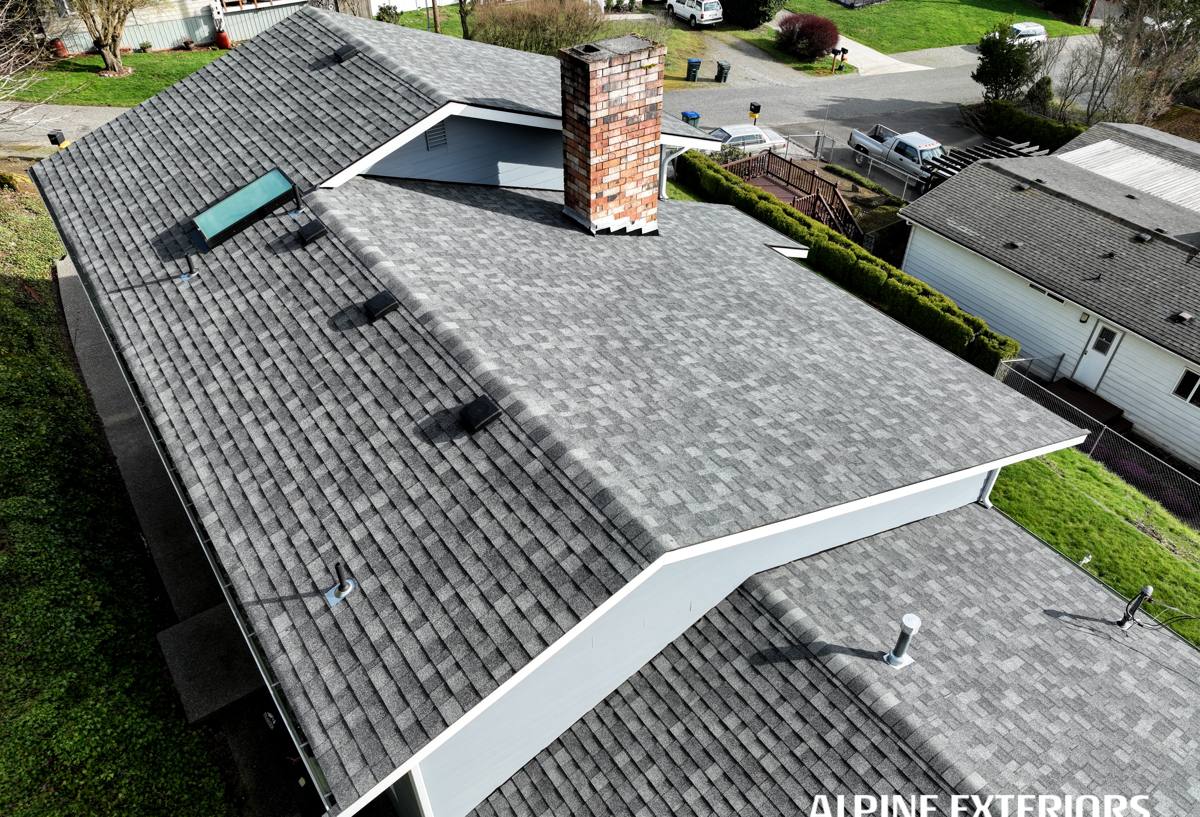
What the Local Climate Actually Does to a Roof
Moss and Algae
Shaded, north-facing slopes and roofs under overhanging trees stay damp for days after a rain. Moss takes hold in that moisture, and as it grows it lifts shingle edges and holds water directly against the roofing material — which accelerates granule loss and rot far faster than plain rain exposure would. By the time moss is visible from the ground, it's usually been working under the shingles for a while already.
Driving, Wind-Driven Rain
Storms coming through the valley don't always fall straight down. Wind-driven rain gets pushed sideways and upward under shingle tabs, around flashing laps, and into any gap that a calmer rain would never reach. This is the single biggest reason we see leaks at valleys, chimneys, and wall-roof intersections rather than in the middle of open shingle fields.
Salt-Bearing Marine Air
Moist air moving inland off the coast carries salt content that accelerates corrosion on exposed metal — nail heads, flashing, gutter hardware, and fasteners. Corroded fasteners lose their grip over time, which is how a roof that looks intact can still have loose shingles in a wind event.
Freeze-Thaw Swings
Whatcom County and the Fraser Valley don't get deep winters, but they do get enough freeze-thaw cycling to open up small cracks in aging flashing sealant and expand any water that's already gotten in behind it. It's a slower process than moss or wind-driven rain, but it compounds the damage those two cause.
Signs a Clearbrook Roof Needs Repair Now, Not Later
- Dark streaking or visible moss patches, especially on shaded or north-facing slopes
- Granules collecting in gutters or at downspout outlets
- Curling, cupping, or lifted shingle edges near valleys and roof-wall intersections
- Water stains on interior ceilings or in the attic, particularly after a windy rainstorm
- Rusted or visibly deteriorated flashing around chimneys, skylights, or vents
- Sagging sections, which can indicate deck rot underneath the roofing material
- Daylight visible through the roof deck when viewed from inside the attic
Any one of these on its own doesn't necessarily mean a full roof replacement. It usually means a repair is due, and the sooner it's addressed the smaller and cheaper that repair stays.
What a Correct Roof Repair Actually Involves
A lot of roof "repairs" amount to a bead of sealant over a visible gap. That buys a season, maybe two, and then the same spot fails again — often worse, because water has now been finding its way in and out through that same weak point. A repair that actually holds up in this climate involves a few things a quick patch skips:
- Finding the real entry point. Water often travels along the deck or underlayment before it shows up as a stain, so the visible drip location isn't always the source. We trace it back before we start replacing anything.
- Re-lapping flashing correctly, not just resealing it. Flashing is supposed to shed water through overlap and gravity, not through caulk. Sealant is a backup, not the primary defense — if a repair relies on sealant alone, it's not really fixed.
- Matching materials and fastening patterns. Mismatched shingle profiles or the wrong nailing pattern can create new high points where wind-driven rain gets a foothold.
- Checking the deck underneath. If plywood or sheathing has gone soft from sustained moisture, replacing shingles over it just hides a structural problem that will resurface.
- Confirming attic ventilation isn't part of the problem. Poor ventilation traps moist air against the underside of the deck, which speeds up rot and can mimic or worsen a roofing leak that isn't actually about the shingles at all.
Repair or Replace? What Actually Drives That Decision
| Factor | Leans Toward Repair | Leans Toward Replacement |
|---|---|---|
| Roof age | Under roughly 12-15 years | Past its expected material lifespan |
| Extent of damage | Localized — one valley, one flashing point, one section | Multiple areas failing, or damage spread across several slopes |
| Moss/algae condition | Surface growth, shingles intact underneath | Granule loss and shingle degradation under the moss |
| Deck condition | Solid, no soft spots | Soft, rotted, or delaminating sheathing |
| Repair history | First or second repair in this area | Same spot repaired multiple times already |
We're upfront when a repair is genuinely the right call — there's no reason to sell a full replacement when a targeted fix will hold. We're equally upfront when a roof has reached the point where repairs are just delaying an inevitable replacement at greater eventual cost.
Our Repair Process
1. On-Site Inspection
We get on the roof, not just on a ladder looking up at it. That means checking the attic side too, since interior moisture signs often tell a more complete story than what's visible from the ground or from photos.
2. Clear, Written Estimate
You get a written scope and price before any work starts — what's being repaired, what materials are being used, and why. No vague line items.
3. The Repair Itself
We work the damaged area properly: pull back enough surrounding material to do the job right, address the deck if needed, re-lap flashing correctly, and match shingles as closely as available product allows.
4. Cleanup and Walkthrough
Debris and old materials go with us. Before we leave, we walk the repair with you so you know exactly what was done and what to watch for going forward.
Why a Crew That Already Works Clearbrook Matters
Roofing itself isn't regionally exotic — good technique is good technique. What matters locally is judgment: knowing that a leak reported after a windstorm is more likely a flashing or wind-driven-rain issue than a straightforward shingle failure, knowing which slopes in this area tend to hold moss longest, and knowing how fast a small, ignored leak turns into deck rot given how much rain this region gets across a typical year. A crew that's regularly working in and around Clearbrook and greater Whatcom County builds that judgment from repetition, not guesswork on a single visit.
There's also a practical logistics side to working near the border. We handle the scheduling and access details that come with working close to the Sumas crossing so that homeowners on either side of the line don't have to think about it — you just get a crew that shows up when it says it will and knows the area well enough not to waste time figuring things out on-site.
Maintenance That Extends the Life of a Repair
A good repair only stays good if the roof around it is maintained. In this climate, that mostly comes down to keeping moisture from sitting where it shouldn't.
- Clean gutters and downspouts at least twice a year — clogged gutters back water up under the roof edge
- Trim back overhanging branches to cut down on the shade and debris that feed moss growth
- Have moss treated before it spreads, rather than after it's visibly widespread
- Check attic ventilation isn't blocked by insulation or debris
- After any major windstorm, do a visual check for lifted or missing shingles
- Address small leaks immediately — a stain the size of a coin now is a much smaller job than the same leak six months later
Get an Honest Look at Your Roof
If you're seeing moss buildup, a leak that shows up only in certain storms, or flashing that's starting to look rough, it's worth getting eyes on it before the next rainy stretch. We'll give you a straightforward assessment of what's actually going on and what it will take to fix it properly — no pressure, no upsell. Fill out the form below for a free estimate.