 Sumas Window
 Siding Built for Everson's Conditions, Not Just Any Climate
Everson sits in a part of Whatcom County where homes deal with a particular combination of weather stresses: long stretches of driving rain off the Fraser Valley and the Salish Sea, marine-influenced air that carries salt and moisture further inland than most homeowners expect, and shaded, damp lots that stay wet long after a storm has passed. Put those together and you get a moss season that runs much longer than it does in drier parts of the state. Moss and algae don't just look bad on siding — they hold moisture against the surface, and moisture held against the wrong material for months at a time is what eventually causes rot, delamination, or paint failure.
Siding installation in this area isn't just about picking a product and nailing it up. It's about choosing a material engineered to shed water instead of absorbing it, and installing it in a way that keeps bulk water and trapped humidity away from your wall assembly. That's the standard we hold every Everson-area siding job to.
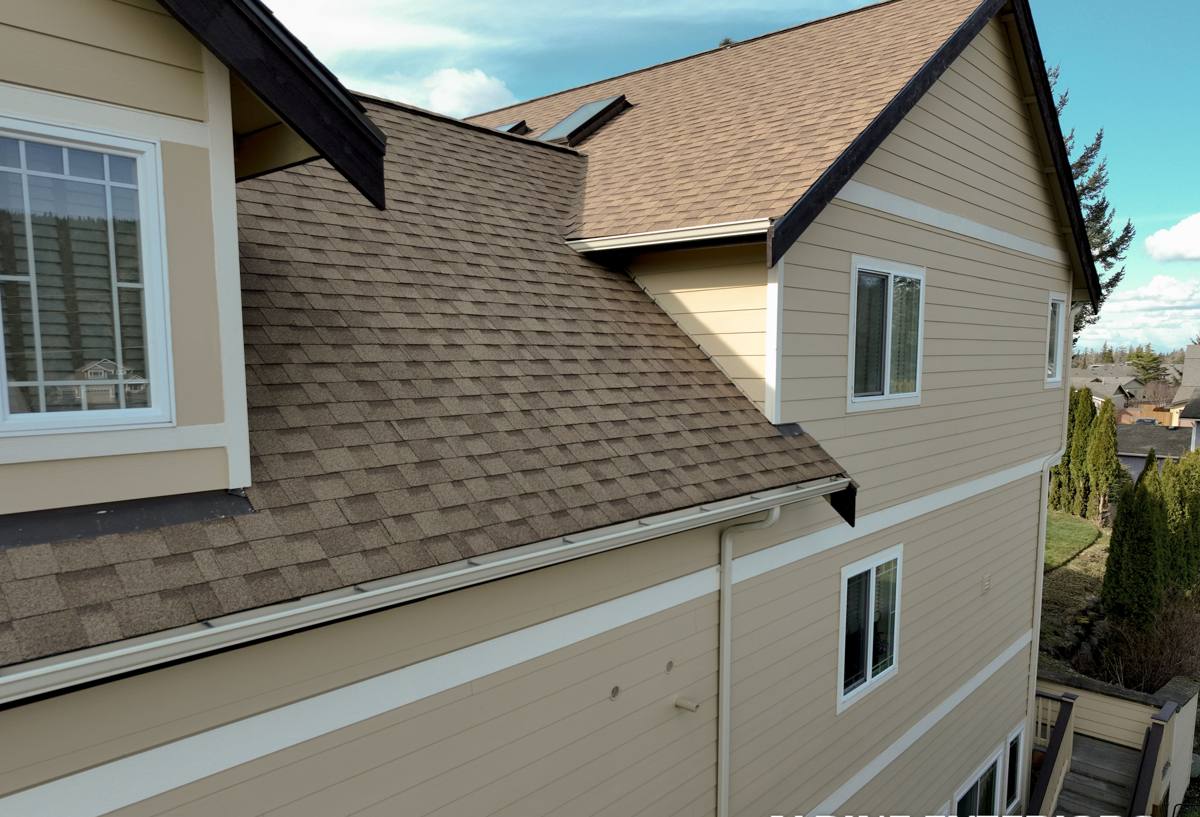
What Correct Siding Installation Actually Involves
A siding job can look finished and still be wrong underneath. The visible plank is maybe 10% of what determines whether siding lasts 10 years or 40. The other 90% is what's behind it and how it's fastened.
The Weather-Resistive Barrier
Every wall needs a continuous water- and air-resistive barrier under the siding, with every seam, penetration, window, and door properly flashed and lapped so water is directed out and down, never trapped behind the wall. In a climate with as much sustained rain as Whatcom County gets, sloppy flashing work is the single most common cause of hidden rot we find when we tear off old siding.
Drainage and Ventilation Gap
Modern fiber cement installation should include a rainscreen gap — a small ventilated space between the back of the siding and the water-resistive barrier. That gap lets any moisture that does get behind the siding drain and dry out instead of sitting against the sheathing. On shaded, north-facing walls (common on wooded Everson lots), this detail matters even more, because those walls dry out slower after every rain.
Fastening and Joint Treatment
James Hardie siding has published fastening specifications — nail type, spacing, penetration depth, and clearance from panel edges — that exist specifically to keep the product performing as engineered. Butt joints, corners, and trim intersections need to be treated (caulked, flashed, or both, depending on the detail) so they don't become the entry point for the next ten years of rain. Skipping or rushing any of this doesn't show up on day one. It shows up in year six or seven, as soft spots, staining, or bowed boards.
Why We Install James Hardie and Nothing Else
We made a decision as a company to install James Hardie fiber cement siding exclusively. We don't install vinyl, LP SmartSide (an engineered wood product), Cemplank or Allura (other fiber cement brands), or primed spruce or cedar. That's not a marketing angle — it's a standard we apply because of what we've seen hold up in this climate and what we're willing to warranty our labor against.
The honest trade-offs with the alternatives
Vinyl siding is affordable and low-maintenance in the sense that it doesn't need paint, but it's a thin plastic product that can warp in temperature swings, crack on cold-weather impact, and it doesn't stop moisture — it just covers whatever is happening behind it, for better or worse. Engineered wood siding (like LP SmartSide) performs reasonably well when installation and caulking are perfect and stays perfect for the life of the product, but wood-based siding is inherently more vulnerable to moisture intrusion at cut edges and joints than a cement-based product, and in a climate with this much sustained wet weather, that's a real long-term risk. Primed cedar and spruce need repainting on a real schedule and are attractive to moisture, insects, and rot if that maintenance schedule slips even a couple of years — which is common once homeowners move in and life gets busy.
What Hardie gets right
James Hardie fiber cement is non-combustible, dimensionally stable (it doesn't expand and contract with moisture the way wood-based products do), and available with a factory-applied ColorPlus finish that's baked on under controlled conditions rather than field-painted on a ladder in variable weather. Hardie also builds climate-specific HZ product lines engineered for the moisture and temperature patterns of different U.S. regions, and backs the product with a strong transferable warranty. None of that guarantees a good outcome by itself — installation quality still matters enormously — but it gives us a material we're confident recommending to every Everson homeowner we work with, not just the ones with the highest budget.
Our Installation Process
- On-site assessment: we look at your current siding (if there is any), check for existing moisture damage, evaluate sun/shade exposure and drainage around the foundation, and measure the full exterior.
- Tear-off and inspection: old siding comes off and we inspect the sheathing underneath for soft spots or rot before anything new goes up. Any damaged sheathing gets addressed before the barrier goes on — covering a problem never fixes it.
- Weather-resistive barrier and flashing: a continuous barrier is installed with proper window, door, and penetration flashing, lapped correctly for water to shed downward and outward.
- Rainscreen/drainage detail: depending on the wall assembly, we install furring or a purpose-built drainage product to create that ventilated gap behind the siding.
- Hardie panel or plank installation: installed to manufacturer fastening specs, with attention to joint spacing, corner details, and trim.
- Caulking, touch-up, and final inspection: factory-finished ColorPlus siding needs minimal field painting, but joints and cut edges are sealed per spec, and we walk the finished job before calling it done.
Signs Your Everson Home's Siding May Already Be Failing
Because so much of what determines siding lifespan happens behind the visible surface, damage is often further along than it looks by the time it's visible. Watch for:
- Soft or spongy spots when you press on the siding, especially near the bottom courses or under windows
- Persistent moss or algae growth that keeps coming back within weeks of cleaning, especially on shaded walls
- Peeling or bubbling paint, or visible wood grain swelling on wood-based siding
- Staining or discoloration streaking down from joints, corners, or window trim
- Visible gaps, warping, or boards that have pulled away from the wall
- A musty smell in an adjacent interior wall or rising utility bills with no other explanation
Any one of these is worth a closer look. Several together usually mean the wall assembly has been taking on moisture for a while, not just the siding surface.
Cost Factors for an Everson Siding Project
Every home is different, and we won't quote a number without seeing the property, but these are the variables that most affect what a siding installation actually costs:
| Factor | Why It Matters |
|---|---|
| Tear-off vs. new construction | Removing and disposing of old siding, plus repairing any hidden sheathing damage, adds labor beyond a bare-wall install |
| Home size and wall complexity | More corners, dormers, and roof intersections mean more flashing detail and cutting, which takes more time to do correctly |
| Siding profile chosen | Lap siding, panel systems, and shingle-style Hardie products differ in material and labor cost |
| ColorPlus vs. field-painted | Factory-finished color adds material cost but removes a repainting cycle from your future maintenance |
| Access and site conditions | Steep grades, mature landscaping, or tight lot lines around Everson properties can affect staging and labor time |
| Underlying sheathing condition | Rot repair discovered during tear-off is a common source of cost variance on older homes |
Why a Crew That Already Works Everson Matters
A siding crew that regularly works this part of Whatcom County knows what to expect before the tear-off even starts. They know that a shaded, north-facing wall on a wooded lot is going to need the drainage detail done right the first time, because it won't get a chance to dry out quickly between rains. They know how long the moss season really runs here and won't undersell you on the maintenance reality of a lower-grade product. And they've likely already seen what happens when flashing or fastening is done wrong on a home a few streets over — which means they're not guessing at what "good enough" looks like in this climate.
That local pattern recognition is worth more than it sounds. It's the difference between a crew executing a generic install and a crew executing an install specifically suited to how water and moisture move through homes in this area.
Maintaining Your New Siding
James Hardie siding is genuinely low-maintenance compared to wood or repainted alternatives, but "low-maintenance" doesn't mean "no maintenance," especially in a climate this wet.
- Rinse siding down once or twice a year with a garden hose to knock off pollen, dust, and early moss growth — avoid high-pressure washing, which can force water behind joints
- Trim back landscaping and tree branches that keep any section of wall in constant shade or damp contact
- Check caulked joints and trim intersections annually and re-caulk if you see cracking or gaps
- Clear debris out of any weep holes or drainage points at the base of the wall
- Address moss regrowth promptly rather than letting it establish over multiple seasons
None of this is heavy work, but a few minutes a couple of times a year goes a long way toward getting the full lifespan out of the installation.
Ready to Talk About Your Home
If your Everson-area home has siding that's showing its age, or you're planning ahead for a replacement, we're happy to take a look and walk you through what we'd recommend and why — no pressure, no obligation. Fill out the form below for a free estimate.